Showing posts with label Daily Life in the Catholic Asylum. Show all posts

Monday, February 06, 2023

The Synodage of Satan.

The Catholic Church announces that it is discontinuing support of its previous OS. 

I mean, TC and the Coddling of the Krauts makes that clear, but I will point to you a recent ballyhooed and vetted statement from one of Rome's most prominent pontifical ideologues, Robert McElroy, broadcast from the pontiff's most important American megaphone.

Note that the link is indirect because washing gas fumes off your gloves is an annoying process. (Fn 1)

If you are looking for a more objective examination of RM's carbon monoxide for the soul, go over to Amy Welborn's discussion here

I have no such interest. Mine is more targeted and less dialoguy--just like his.

When you wade through RM's explanation for what the Synodalite Church will offer, I ask that you pause a moment at his use of the term "demonic." It's how he describes what he believes to be the animus that "so many men and women" have towards the LGBT community.

And he places this spiritual indictment, which he regards as a self-evident fact, in the midst of a deeply, deeply fraudulent discussion about how the Synodalite Church really, really wants to embrace everyone.

Sure, Robert.

For starters, there is no shortage of men and women who think your life as an accessory to the predatory corruption of Cardinal McCarrick (Fn 2) makes you uniquely unqualified to call any non-sociopath "demonic." 

Not to mention that you, of all people, offer a truly hideous example of how to embrace "victims of clergy sexual abuse." 

But you know: senses of shame and Catholic hierarchs go together like arsenic and Thanksgiving.

I, on the other hand, am a bit ambivalent on the former point: after all, your career just might give you an up close and personal insight into the phenomenon of demonic activity. Be that as it may, that's ultimately going to be hashed out between you and God.

Further, and going back to the third person, I'm not really interested in the part of the Culture War which he highlights and the side he clearly wishes to take. I only note it because it comes as part of a paragraph with ends with the following Rome-approved message:

Rather, the dignity of every person as a child of God struggling in this world, and the loving outreach of God, must be the heart, soul, face and substance of the church’s stance and pastoral action.

If my nearly 24 years as a Catholic has taught me nothing else, it's that when clerics lie, they lie big. Hellishly so. As in, "have I got a Donation of Constantine for you!"

For the love of Pete, the paragraph starts with calling fellow Catholics demonic and then ends with a call to recognize the dignity of each soul.

Editing at America is evidently not a strenuous job.

Sure, why not?

The rest of the verbiage from his approved interoffice memo makes clear that that sentence is a titanic fraud, limited only to those he likes. And if you are attached to the old Catholic OS, too bad so sad.

We aren't supporting that any more. 

It's being sunsetted. 

Time to upgrade to Catholicism's Windows Vista. The one where Contemporary Conscience Trumps All.

Not only is your fidelity not enough, RM makes sure you know it is a huge part of the problem, what with your racism, hatred of the poor and your un-upgraded conscience with its sexual fixations [Oh, great: another projection meter just detonated]. 

Worse yet, you unenlightened kine also "perceive doctrinal infidelity in that [radical] inclusion." Hell, your perceived doctrinal fidelity probably clutters Our Common Home™ with people you care for first instead of being radically inclusive.

Get with the program. 

The Current Pope Has Spoken. 

Sacrifice is for losers, and worse yet, gives the people whose approval we really want the wrong idea.

Anyway, it's easier this way--jump right in, the water's lukewarm.

And note that Radically-Inclusive RM is showing us the way in his personal diktats, shutting down the old liturgy in his diocese that was just fine until the Current Roman Oracle got testy. Radical Inclusivity™ always has limits. Especially for those who stubbornly insist on believing that outdated shit.

Besides, you lay types have already shown them there's no end to what you will take. 

And if they have to, they'll just weaponize Jesus and ask you where are you going to go? 

For once, they'll solemnly say that it's Jesus' Church, and He has the words of eternal life.

As filtered through them and their Lord Vetinari-ish communing with the Spirit.

So you'll shake your head, sigh heavily and stay. Because that's what Catholics do. Obey.

And then next year you'll get the latest ad-hominem laden missive from the Spirit, reminding you what else needs to be downsized from your soul....


[Footnote 1: The link is to Abp. Aquila, by all reports a fine man and sound modern shepherd. But honestly, quoting the current pope as a rebuttal to McElroy reads like Grigory Zinoviev trying to quote the General Secretary to defend himself in his show trial. So I will leave to others to suss out the effectiveness of his essay. I will say this: at least he responded, knowing that RM had Rome's imprimatur.]

 [Footnote 2: Please note that the New, Inclusive, Caring and Transparent Synodal Church of Vos Estis and the Other Window-Dressing That Ought To Hold The Little Bastards has not seen fit to actually show us the documentation for Cardinal McCarrick's laicisation. Ditto the underlying survey material that supposedly drives all of its Just Listened to the Spirit With Our Sibs--Honest! door-slamming. 

So until then, I will continue to refer to that well-connected rapist, network-builder and fundraiser par excellence as "Cardinal."]

Monday, January 30, 2023

A worthwhile read.

 The Vatican Dogma, by Fr. Sergius Bulgakov. 

Published in 1946, it presents a detailed, albeit polemical, argument against Vatican I. It deserves consideration. It was not Catholicism's most edifying hour, to put it mildly:

To begin with, bishops, of whom a church council is normally composed, are present there as representing, or bearing witness for, their respective dioceses—there can only be a council when people give and take counsel. But in this case there could have been no such thing, since the very purpose of the Council had been kept secret. No one knew why it was being called, and its main object was revealed only after it had assembled, though the leading party—the Jesuits­—had a fairly clear notion of it. The papal allocution of 26.VI.1867 referred to convoking the Council, but during the two and a half years that passed not a single question of importance was put down for its de­liberation. The committee of theologians, which under the chairmanship of a cardinal was preparing the agenda, did not inform the episcopate of the result of its labours. Thus secrecy enveloped the Council's transactions from the first.

 When the delegates arrived, they received printed instructions from the pope who had already appointed all the officials of the Council. The instructions made provision for several committees, but the chief commit­tee of projects, apart from which no resolutions could be proposed, had already been appointed by the pope. The two other committees were elected by a simple ma­jority vote, but the majority clearly belonged to the papal party, because of the composition of the Council. The three committees included only about a hundred persons, i.e. one sixth or one seventh of the total num­ber of the members, which varied from 764 to 601. The rest remained in enforced inactivity, and were not even allowed to hold private consultations. They had to languish in the expectation of general meetings for which no definite times were fixed. While the Council was still sitting, the instructions were changed by the pope and made more stringent. General meetings were held in a hall with such bad acoustics that most of those present could not hear the speakers at all; the chairman had the right to determine the order in which the speakers were to address the audi­ence, and to stop the discussions. Members of the Council were presented with certain resolutions drawn up by the committees; they had no books at their dis­posal (the Vatican library was closed to them) and had only a few days to prepare themselves for discussion meetings. There was a general atmosphere of eaves­dropping and espionage, of which many delegates complained. In view of all this, the proceedings can hardly be described as a Council; letters and much other material that has been published make abundantly clear the dejection and even dismay that possessed its members[4].

But, it will be asked, how could all the bishops present give their consent to something that was repug­nant to the conscience of many of them? It is not as though they were threatened with the Bolshevist hor­rors, torture and death; at the worst, their career would have been spoiled. The explanation is, in the first place, that the composition of the Council had been pre-arranged, so as to secure a majority obedient to the pope. This was done by including, in addition to real bishops representing their diocese, a considerable number of titular bishops who represented no diocese whatever and were, at bottom, simply obedient officials of the pope’s consistory, and also of men who were not bishops at all—cardinals and generals of different orders[5].

 The overwhelming number of diocesan bishops were Italian (out of the total number of 541 European bishops, Italy had 276, Austria-Hungary—­48, France—84, Germany— 19). It is clear enough what this preponderance of Italian bishops meant: they were directly subordinate to the pope as their patriarch and entirely dominated by Rome. The non-diocesan members of the Council together with the disproportio­nate number of Italian bishops constituted a majority which could carry any resolution submitted to the meet­ing. This is precisely what happened.

The gruesome aftermath is also worth noting, as the Melkite patriarch was literally battered by Pius IX's guards during an ad limina visit following a statement of the patriarch's reservations.


Friday, February 11, 2022

The Listening Church's American Point Man Reminds Us He's a Vicious Twerp.

A principal in a Chicago Catholic school, correctly noting the risk/harm factors, made masks optional in his school.

Naturally, Blase Cardinal Toadych immediately suspended the man. Because his authority is more important than anything else--especially the well-being of mere students.

Thank you, JPII, for making this brittle, tyrannical fraud a bishop.  

In Nevada, a place not run by someone drunk on authoritarianism, liberated school children rejoice in the end of the mask mandate.

Friday, January 28, 2022

Ad orientem is forbidden in the Catholic Diocese of Venice. But...

Frank Dewane, the bishop of Venice, Florida, got word that some of his priests were celebrating the new form of the Latin Church's worship ad orientem

So he's trying to squash that.

Meanwhile, here is a fully-compliant, a-ok with the Ordinary mass in the same diocese.

That is "what serves the common spiritual good of the People of God, rather than private inclination or arbitrary choice."  

That meets his "vigilance over the whole of the Diocese's liturgical life."

Look, I can understand a bishop allowing Sacred Heart-type parishes their peculiarities. But the same latitude should be extended to parishes that face east.

But not in the situationally-deaf "listening church," alas.

In the faux open church, you can do anything with the new order of mass except make it look or sound (how many Latin NOs are there?) anything like what proceeded it. And so it is with the Reverend Dewane: livestreamed hammy pastors with constant ad-libs and close-ups are what mass is permitted to be. A priest facing east--no, hell no and nuh-uh too.

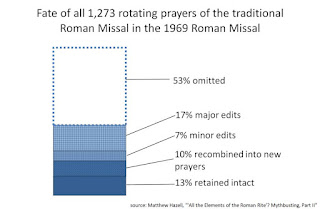
And for all those garbage people in Venice "who[] wish[] to celebrate with devotion according to earlier forms of the liturgy" where they "can find in the reformed Roman Missal according to Vatican Council II all the elements of the Roman Rite"?

Ad orientem is verboten, but Sacred Heart passes muster.

Yeah, that ought to hold the little bastards. What the Rev. Dewane thinks of such retrograde devotion to the Roman Rite is abundantly obvious.

I mean, the above-quoted part about finding all the elements of the old liturgy in the new is 13 percent true. 

To be fair: as Groot would point out, that is better than 12 percent.


And then there's the shredded liturgical calendar, making the Roman Canon optional and thus almost extinct, etc.

Yeah, well, too bad. "Unaltered faith and uninterrupted and living tradition"--because they say so. Arguments from authority are the only arguments that matter in the Latin Church.

Besides, Sacred Heart is part of that continuity because the vigilant bishop says so, too. And you ad orientem types are not--also because the vigilant bishop says so. All the seal of approval you dare to ask for.

A cynic might think that the old rite has to be crushed to destroy the evidence of the before time. The Listening Church does not enjoy questions that suggest it is anything short of omni-competent.

La la la can't hear you!

Anyway, schismo, the bishop's annual appeal is coming up: open that wallet.


Tuesday, January 18, 2022

It is to laugh.

Rest assured, paternalistic hierarchs, there is nothing that excites contempt or incites animosity more than your words and actions. 

Now that you have shot the messenger, you can safely return to planning the next round of parish closings and property sales. 


Thursday, January 13, 2022

Adam DeVille has a proposal for genuine synodality.

Genuine: as in not the "Are you using the TPS cover sheets for the Bishop's Annual Appeal?" variety.

And I'm on board with all of them.

 (1) Synods in every diocese where clerics and laics are on equal footing with voice and vote to meet annually in full session, and as often as necessary between sessions in a standing or permanent synod.

(2) Synods in every diocese that vote annually on the bishop’s proposed budget, priorities, and policies, including those governing liturgical rites.

(3) Synods in every diocese which, during their annual meeting, have a right to pass a motion of censure or non-confidence in their bishop for egregious abuses of money, power, and sex.

(4) Synods in every diocese that meet to elect a new bishop when the old one dies or retires.

(5) Synods in every ecclesiastical province that elect the metropolitan archbishop and function under his presidency as disciplinary tribunals for diocesan bishops charged with various forms of malfeasance, including covering up sexual abuse. These synods can depose bishops if found guilty, but bishops can appeal to #6, below, and ultimately to Rome if necessary.

(6) Synods in every region or country that meet to elect a patriarch or catholicos under whose presidency the synod will function as a court to try archbishops, and as an appellate court to hear appeals from metropolitan synods.

(7) Synods in every country that elect a slate of electors to be sent to the next papal conclave. After all, as Pope Celestine I (422–432) said, “the one who is to be head over all should be elected by all.”

In a church where godless, murdering Communists get a say in who the bishops are and how the faithful worship, there is no good reason I should not, either.

But that's not going to happen right now. Vatican II is just the triumphalist sequel to Vatican I decked out with ostentatiously-humble buzzwords on flair buttons. Accompanied by the time-tested Lord Vetinari approach to manufactured consensus.

Because the only thing the current iteration of Rome loves more than chasing after foreign princes, gods and fads is her own power. 

And yet, fortunately for her long-term well-being, the demographic trap door is opening under her feet. Humility will follow with the realization that she is not supposed to be a serial personality cult but the Body of Christ. When it does, all sorts of possibilities will open up.

It can't happen too soon, but, alas, it won't happen in the lifetime of us older coots.


Monday, January 03, 2022

Grover Cardinal Dill.

One of the following people to the front left is a klutzy toady who apes with shrill cartoonishness the mean-spirited gent who gives him whatever prominence he possesses.

The other is a fictional character portrayed by Yano Anaya in the classic film A Christmas Story.


A good branch manager always rigorously enforces the latest memos from HQ. Note the good practice posing with a picture of the CEO while next to said CEO.

On the other side of the world, murderous communists pick bishops for the Catholic faithful it routinely disappears in the world's most populous country.

"Religion with Chinese characteristics" = "German Christians 2.0."

But that's OK with Rome. Dialogue is a jealous god, and sometimes you have to sacrifice Catholics to totalitarianism to keep it going.

However, advertising the Latin Mass in a parish bulletin? Kill it with fire!

Meanwhile, you, non-subject of the People's Republic? You get the result of the manic, ahistorical centralization that has possessed Rome since the beginning of the 20th century.

The odor of Late Stage Clown Church grows more pungent by the day.

[Update: For context, here is an acceptable form of liturgy for the ordinary of Chicago, worthy of advertisement in the parish bulletin. Unlike ad orientem celebrations, you don't need the the Cardinal's permission to omit the greeting, penitential act, or opening prayer.

I'd say good to know, but we already know bishops really don't give a shit about what happens at a NO mass--so long as it isn't anything that smacks of the TLM. Other than that, have at it and your shepherd will shrug. He's a busy man, after all--he has another large round of parish closings to plan for.]

Thursday, December 02, 2021

Wait and see.

And if the plans for the interior of Notre Dame de Paris are in fact a Pantheism Epcot, then you can bay for the heads of Catholic diocesan bureaucrats to put a stop to it.

What is interesting about The Architect's Newspaper article is this: underneath all of the framing about traditionalist anger and pouncing conservatives, there's a recognition that what has been described is a bad idea. 

Hence the repeated reminders that none of the proposals are unalterable and much could change:

“What they are proposing to do to Notre-Dame would never be done to Westminster Abbey or Saint Peter’s in Rome,” lamented Paris-based architect and urbanist Maurice Culot to The Telegraph. “It’s a kind of theme park and very childish and trivial given the grandeur of the place.”

As mentioned, none of the features detailed above are set in stone and church officials will publicly reveal proposed changes to the church’s interior on December 9 when a host of approaches under consideration come under review by France’s National Heritage and Architecture Commission. Like any other culturally and historically sensitive restoration project of this scale, much could change between now and 2024.

A parting thought: pace Maurice Culot, I do not have much difficulty imagining the powers that be doing the same thing to Saint Peter's. 

The past several generations have seen Catholic tastemakers doggedly trying to replace one form of kitsch (real or imagined) with their own vision, which comes with a much shorter use-by date than they think, itself turning into kitsch. 

What stops the Vatican from doing so is the loss of tourism income. 

Which itself proves that tourists from across the globe do not need LED light shows to appreciate Catholic houses of worship and art.


Tuesday, November 23, 2021

The root of the Catholic Church's endless crisis? Lying to itself.

Amongst the too-many pieces of unsolicited advice I give my children is to not lie to themselves, either. Once falsehood becomes one of your mental navigation tools, you are headed to shipwreck.

Lying always takes a toll on you. Even if no one else sees it and there are no immediate repercussions.

But when it becomes institutionalized? 

It wrecks other people's lives, too. No matter how much you would like to pretend otherwise.

Which brings me to this Pillar story about the hellish priest from Cleveland, Robert McWilliams, whom the federal authorities have thankfully locked away for life.

When a federal judge decided this month on a prison sentence for Fr. Robert McWilliams — convicted of child abuse, child pornography, and child trafficking — she had two versions of past events from which to choose.

In the account of McWilliams’ lawyer, the priest needed help, therapeutic treatment, to address the “demons from his childhood” which influenced the heinous crimes of his adult life.

The “demons” were not specified, but since a prosecutor’s memo spent several pages discussing the correlation between suffering abuse and committing it, it’s reasonable to presume that’s what McWilliam’s attorney was getting at.

But the prosecutor argued that McWilliams was not “corralled into a crime by a series of unfortunate life circumstances.” Instead, her assessment was blunt: McWilliams was “cruel,” “calculating,” and a “sociopath.”

The judge who sentenced McWilliams to life in federal prison seemed to align with the prosecution.

But whether McWilliams is more like an unfeeling Hannibal Lecter or instead a damaged, criminally unmoored Buffalo Bill, both accounts leave the Diocese of Cleveland in a difficult position.

Either its seminary was unable to weed out a sociopath ordained a priest just five years ago, or it was unable to realize that a deranged and unstable trauma victim was unsuitable for priestly ministry. 

That is the sort of horror that makes honest people and institutions take stock and make changes.

So what is the response of the leadership of the Cleveland diocese to their ordination of Buffalo Lecter?

Seminary screening is not perfect, nor is it foolproof. But when the system is beaten, most observers would expect a thorough postmortem — the kind that results in a clearly articulated set of changes, and a public commitment to follow through on them.

In Cleveland, seminary administrators have said thus far that the McWilliams saga hasn’t really suggested to them any particular changes they ought to make. That prompted one victim of McWilliams to suggest last week those administrators need, as it were, to take “their heads out of their asses.”

If a seminary doesn’t see an evaluative failure in the ordination of a sociopath, some Catholics have asked, what certitude can be had that McWilliams is the only one to graduate from the place? If there aren’t specific failures to recognize and to change, is it reasonable to conclude the failures are systemic, and the changes must be, too? 

But a thorough, impartial investigation might turn up blameworthy clerics. 

Worse, it could upset the leadership's equilibrium, cause it to question itself and tell it that real penance and reform are necessary.

Better to just maintain the self-deception that everything is basically fine.

We are an Easter People.

Forward in Hope. 

Your Preferred Tuneful Whistle Past the Graveyard.

Despite the blaring klaxons, closing parishes and all the other evidence to the contrary.


Friday, November 19, 2021

There's a lot to be said about the USCCB's Eucharist confab.

But I will leave most of that to Amy Welborn.

Were there really some Catholics on Twitter accusing Archbishop Jose Gomez of dog-whistling for "White Nationalism"? For saying this?

Archbishop Ireland believed deeply in what Reverend Martin Luther King and others have called the “American creed” — the belief expressed in our founding documents, that all men and women are created equal and endowed with sacred dignity, a transcendent destiny, and rights that must never be denied.

Yep, I can hear Charlottesville Tikists cheering from here. 

There's nothing they love more than hearing a Mexican-born immigration advocate quote MLK Jr.


But of course there were Catholics spitting outrage. I'm not looking for them, but there's no shortage of prominent [adjust values of "prominent" for being a Catholic twitterer] ones who have merged politics with faith who could say such things.

Keep talking--there are few things that make the Faith more toxic than cloaking your politics in its dead, flayed flesh.

Speaking of the Faith as a skin-suit, let's look at the nuncio's commentary at the conference:

Realities are more important than ideas. We can have all the theological ideas about the Eucharist – and, of course, we need this – but none of these ideas compare with the reality of the Eucharistic Mystery, which needs to be discovered and rediscovered through the practical experience of the Church, living in communion, particularly in this time of pandemic. We can become so concentrated upon the sacrality of forms of the liturgy that we miss the true encounter with His Real Presence. There is the temptation to treat the Eucharist as something to be offered to the privileged few rather than to seek to walk with those whose theology or discipleship is falling short, assisting them to understand and appreciate the gift of the Eucharist and helping them to overcome their difficulties. Rather than remaining trapped in an “ideology of the sacred”, synodality is a method that helps us to discover together a way forward.

Now, remember that the essential job function of a nuncio in the current era is to make sure everyone bellies up to the pontifical word salad bar--no matter deficient in mental nutrition it turns out to be.

"Realities are more important than ideas" being a particularly dumb piece of sloganeering. 

There's nothing more real than a motivating idea in the soul of a human being. People struggle and die for ideas every day, and change the grim realities they live in into something better because of them. If you think of the dumb slogan as a verbal truncheon to be swung at ecclesiastical opponents, it might make slightly more sense, at least as a tactic. But it's still  worthy of contempt.

Taken on its face, it is a pernicious argument for stasis and privilege. 

And, speaking of privilege: the bleak irony is that privilege is precisely what the nuncio and those who fret about "the weaponization of the Eucharist" are defending.

The right of privileged Catholic political elites to do whatever the Hell they want in their public lives despite the grim contradictions to the faith they loudly profess.

For a regime that talks about championing the poor, those on peripheries, and other related ideas, the reality truly is greater than ideas: the pontiff has no trouble kissing up to the privileged and the powerful and tossing the weak, poor and peripheral to the side.

And by taking the side of Catholic ruling castes to ensure that they get their wafers every Sunday, this privilege is made ironclad. Those Catholics who wrestle with conscience and decide to stay in the pews when the communion line forms? The message from the top is that you're chumps and almost certainly suspect for adhering to the Old Piety. 

More to the point: you struggling nobodies in the pews can't cut the Church out of the public grant money.

Thursday, November 18, 2021

It's seasonal Catholic catalog time!

And hoo, boy--am I tired of seeing Archbishop Vigano everywhere.

His decision to become an Omnipundit--ghostwritten or otherwise--was a spiritual own-goal.

Publishers feeding into it only makes it worse. 

Here's an idea for both parties:


Nothing says "lively pastoral charity" like denying extreme unction to the dying.

I saw this yesterday, but it did not sink in until Kevin Tierney pointed it out.

The bishop of Charleston leaves the spiritual equivalent of a flaming bag of crap on the porches of his sheep. Only a contemptible ideologue or equally contemptible company man could try to legislate this. 

But it matters not at all which he is. Click on the picture to magnify.


What matters is that the gratuitous cruelty of the law invites disobedience, so here's hoping it is ignored when those members of the faithful seek it anyway.  

Salus animarum suprema lex.


Tuesday, November 16, 2021

So apparently there's this attempted hatchet job of a book about Scott Hahn.

I've been reliably informed that it is a padded version of a doctoral dissertation by some assistant professor.

I have also been reliably informed that it is, like many dissertations, Not Good At All

I know that without reading it.

Gasp--that's not fair!

Normally, yes.

But all rules have exceptions, and here's one: any religious tome that has an insult in the title is candidly admitting to you that it is Not Good At All.

And as sure as the Almighty made lots and lots of beetles, this one flings the classic insult "fundamentalist."

As the philosopher Alvin Plantinga memorably put it, "fundamentalist" just means "sumbitch":

 We must first look into the use of this term ‘fundamentalist’. On the most common contemporary academic use of the term, it is a term of abuse or disapprobation, rather like ‘son of a bitch’, more exactly ‘sonovabitch’, or perhaps still more exactly (at least according to those authorities who look to the Old West as normative on matters of pronunciation) ‘sumbitch’. When the term is used in this way, no definition of it is ordinarily given. (If you called someone a sumbitch, would you feel obliged first to define the term?) 

Still, there is a bit more to the meaning of ‘fundamentalist’ (in this widely current use): it isn’t simply a term of abuse. In addition to its emotive force, it does have some cognitive content, and ordinarily denotes relatively conservative theological views. That makes it more like ‘stupid sumbitch’ (or maybe ‘fascist sumbitch’?) than ‘sumbitch’ simpliciter. It isn’t exactly like that term either, however, because its cognitive content can expand and contract on demand; its content seems to depend on who is using it. 

In the mouths of certain liberal theologians, for example, it tends to denote any who accept traditional Christianity, including Augustine, Aquinas, Luther, Calvin, and Barth; in the mouths of devout secularists like Richard Dawkins or Daniel Dennett, it tends to denote anyone who believes there is such a person as God. 

The explanation is that the term has a certain indexical element: its cognitive content is given by the phrase ‘considerably to the right, theologically speaking, of me and my enlightened friends.’ The full meaning of the term, therefore (in this use), can be given by something like ‘stupid sumbitch whose theological opinions are considerably to the right of mine’. 

--Alvin Plantinga, Warranted Christian Belief (Oxford: 2000),  245.

Thus, to summarize: some guy with tenure at a small college devoted his dissertation to venting about that "stupid sumbitch" Scott Hahn. And then he gussied it up a bit for a wider audience. 

(Re-)publish or perish!

Truly a work destined for Dollar Tree's shelves, right next to the remainders from failed politicians paid to have someone ghostwrite about My Vision For America.

The trees that died for books by Harry Reid and Tim Pawlenty... And the academic equivalent of an "I HATE THAT GUY" Reddit page joins them--albeit in a much tinier print run.

The real scandal is that someone handed the guy a doctorate for it, but it's not my alma mater, so whatever. 

The correct response to this trivial ankle-biter is to not boost the signal. And that includes not linking to the debunkings of the, uh, work, either. Anything else will only boost the print run, and encourage more of the same.


Tuesday, November 09, 2021

"Who controls the past controls the future. Who controls the present controls the past."

It is impossible to escape the memory hole resonances wafting off the Party in power in Rome.

Or, to be candid, the Church in general.

Gaslighting for everyone!

Consummate company man Rev. Arthur Roche asserts that popes have the power to abolish the liturgy, demonstrating his loyalty to the chap who promoted him to ultimate curial power.

He also says that the church has a new ecclesiology after The Polestar Council, and the worship offered during The Polestar Council is contrary to it. 

A more cynical fellow might think that continuity with the Tradition of the Church is open to serious question here.

Despite the previous pontiff stating the precise opposite, in closely-reasoned detail, just fourteen years ago. As the Reverend Roche is acutely aware. 

The bigger question is this: given their clearly-contingent nature, subject to revision at the whim of those in power, why would any sane human being accept any edict from Rome?

I'm not talking about Papa Krishna folks who conflate reigning popes with the Holy Spirit, unblinking, misguided clericalists who value exercises of power over reason.

No, I'm talking about people who still value reason over exercises of power. 

Why should I listen to authorities who reject any authority save themselves?

Their eagerness to shred tradition, custom and precedent leaves them with only the appeal to their own power and the will to exercise it.

Miguel de Unamuno was a Spanish philosopher and novelist who is very hard to categorize. I am morally certain he would be delighted to hear that assessment. I will have a post about this most Spanish of philosophers once I finish his vexing and intriguing Tragic Sense of Life.

Near the beginning of the Spanish Civil War, on October 12, 1936, he engaged in a debate with Millan Astray, an officer in the Spanish Legion, at the University of Salamanca regarding the War. In a quote attributed to him (1), he castigated the notion of might making right in no uncertain terms:

You will win because you have enough brute force. But you will not convince. For to convince you need to persuade. And in order to persuade you would need what you lack: Reason and Right.

And so it is here: they have the power, and that will suffice for their purposes.

But that does not mean anyone has to accept such exercises.


Footnote (1): That Unamuno said the words attributed to him is subject to serious historical question. The earliest record of these words was after the War, and Spanish researchers have recently raised doubts as to their provenance.


Monday, November 08, 2021

The Holy Ghost never gaslights.


Amy Welborn has been publishing regular essays about how the trope of "the spirit is doing a new thing!" is frequently an exercise in both political power-grabs and weaponized, spiritual bullying. 

It has been exceptionally worthwhile, and the latest installment is here.

In her latest post, she emphasizes that, despite all of the cooing moderns do into the mirror, we are fundamentally the same people as those who traversed this vale of tears before we were literally pushed into the light of day. 

We are so different, it seems. Our lives are radically different.

Aren’t they?

Yes? No?

I maintain, fundamentally, no. Fundamentally. Of course our external circumstances impact us profoundly. I’ve long believed that widespread relative prosperity and mobility have had a deep impact on the way that human beings understand themselves and the spiritual journey. Carl Trueman’s The Rise and Triumph of the Modern Self takes on these changes from a different perspective, and I largely agree with his assessment. Me, sitting here in Alabama, knowing that if I wanted to spend the money, could get on a plane and fly across the country – and then be back home tomorrow and can instantly communicate with friends around the world – is a life quite different from the woman of the past who might never have left her own village.

So yes! The externals have changed, the framework has changed, the assumptions have shifted.

But

Also no.

And that no is the reason we can read two-hundred year old novels, four-hundred year old philosophical works, eight-hundred year old plays and three-thousand year old epics and still see ourselves.

It is a shock to the system, really, the first time a young person reads the first book of Augustine’s Confessions and sees such a wildly familiar landscape, even in the strangeness of it all: she sees parents who don’t understand, parents who don’t get along, career expectations, temptations succumbed to for unknown reasons, other temptations succumbed to that leave one empty in the end, ways to waste time, education that becomes less vital the more it’s required, and of course, questions. Question after question after question. 

* * *

I have written before that as a teacher – both in the classroom, at home, and in my writing – I have long taken it as my responsibility – and great pleasure, in fact – to help students and readers dig through the initial strangeness of history, of literature, of theology and spiritual writing, of the lives of the saints, and indeed, of Scripture itself – to understand what is essentially and even eternally true there and to see that the questions posed in these works and traditions are, indeed, the same questions they grapple with. They are not alone. They are not the first to wonder. Which should, indeed, come as a tremendous relief, and a moment of yes, communion across space and time.

So the question – yet another question – remains, stubbornly. And I would pose it regularly, if I could, in person.

Why is it permissible to reflect on and benefit from the wisdom, truth and beauty in every corner of the history of the People of God and even outside of its boundaries – except in the ancient liturgical prayer of the Church, actually being prayed?

Emphasis in original.

As I said at the beginning, it is part of a recurring series, so work your way back through her blog posts on the topic--starting with this one

Her thinking through of the issues should be compared to the most recent corporate bishop-speak on Why We Must Flush All Of That. For example, take the Cardinal Archbishop of Chicago, Blase Cupich. In a blog post at Pray Tell, he explains why we all must move on, get with the Vatican II paradigm shift, embrace the break with the past and obey his pope-given pastoral authority.

Which will sound more like "authoritah" when he tosses the Latin Mass-goers out on their arses in a few months. 

He'll probably let that type have Christmas. Probably.

But this is the same guy who literally locked the FSSP out of their parish during Holy Week in 2002, so...don't bet more than your couch cushion change on it.

In return, he "may" (his word) let you have some of that equally-outdated chant crap, bits of dead language or even an additional minute or so of silence. This last most likely carefully dispersed throughout the service so as not to offend the Chief Liturgist of Chicago. If you're not bustling about like Martha, you're doing it wrong.

Of course, any parishes that do so with the Latin, etc., will be watched with the hairiest sets of eyeballs in the Windy City when they so do.

The Archbishop being who he is, he can't help but say something fatuous even as he drops heavy-handed "pastoral" thunderstorm warnings.

A second guiding principle the pope addresses in TC is that there has to be a solid unequivocal recognition on the part of all Catholics that the Second Vatican Council and its reforms are not only an authentic action of the Holy Spirit but also are in continuity with the Tradition of the Church.

Emphasis in original.

How about "no"? And "wrong"? 

Throughout history, the Holy Ghost has only guaranteed that the collected batches of mitred men and their clerical advisers gathered at ecumenical councils--who have run the gamut from capital-s Saints to perverts and heretics--will not irretrievably screw things up. 

More to the point, He certainly does not guarantee that, post-council, a much smaller group of men appointed by the pope, also running from saintly to godawful, will correctly synthesize what that larger group may or may not have wanted.

What He did guarantee is that what Catholics receive from their altar (or whatever else it might be called these days) continues to be the Eucharistic Christ--Body and Blood, Soul and Divinity.

Because, really--it takes about five minutes of research to discover that what the Smaller Group of Guys produced wasn't really what was expected. For example, all vernacular, all the time! wasn't the idea, according to one of the liturgical periti writing as the Council was in session:

It is noteworthy that this question was the most discussed in all the debate on the liturgy. Eighty-one speakers were heard. Their opinions take up more than 100 solid pages. Three tendencies were manifested: 

Some wanted no concessions to the vernacular; some wanted permission to say everything in the vernacular for all who want it; some wanted to maintain the basic principle of Latin, but also to open the door noticeably to the vernacular tongue. The majority were of this middle view, which was that followed by the schema. 

Thus the way of prudence and of apostolic boldness were amicably united. The Second Vatican Council, officially introducing bilingualism into the life of the Latin liturgy, takes a memorable stride in history.

So much for "what the Council wanted," as monolingualism became the norm in 1970. Sounds like the authentic voice of the Holy Spirit was gagged, not heard.

But, of course, noting that the Emperor's floppy bits keep popping out makes one borderline schismatic and definitely out of tune with the new thing.

Naturally, then, I will push one more button. The Cardinal points to the new calendar, with "Hey, new saints!" 

I will respond by pointing to the commentary of Fr. Louis Bouyer, the most eminent liturgist on the Concilium that promulgated the spirit-protected, in-continuity-with-Tradition-honest new liturgical calendar:

I prefer to say nothing, or so little of the new calendar, the handiwork of a trio of maniacs who suppressed, with no good reason, Septuagesima and the Octave of Pentecost and who scattered three quarters of the Saints higgledy-piddledy, all based on notions of their own!

Because these three hotheads obstinately refused to change anything to their work and because the Pope wanted to finish up quickly to avoid letting the chaos out of hand, their project, however insane, was accepted!

"In continuity with the Tradition of the Church," huh?

Yo tengo muchas preguntas, arzobispo.

In the final analysis, it does not matter if the Cardinal is aware of the problems with his argument (such as it is). 

The facts are easily discoverable, and the desire for something more rooted will not go away. No matter how much he and those of like mind try to resolve the issue with a toxic mix of brute exercises of authority and patronizing rhetoric. Ordering people to move on is like ordering them to shut up--it does not work, long term. 

When you throw in the reality that your institutional credibility hovers around that of telephone scam artists from Hyderabad, it guarantees that only bad things will happen.


Friday, November 05, 2021

A "good Catholic"?

So two elderly politicians met in Rome, and the less-compos mentis one reported that he had received the papal seal of approval from the one who has his stuff together.

Yeah, it's true. Despite, you know, big-footing the collegial shepherd(s) that That Council said were supposed to have authority over such matters. The Humble Pastor from The Argentine has a Boniface VIII streak that runs rampant...but you already know that. 

[Thanks to Don for the link immediately above.]

I'll admit that this latest petty political gamesmanship threw me for a loop for a few hours, then I brushed off our Roman pontiff who demands submission's latest headgames and went about my business. It was a clericalist shin-kick to the American bishops who aren't on-board with the spiritual hospice idea and nothing more. 

[I am almost inclined to think that--just perhaps--it was a misguided kindness done to a increasingly-feeble old man. After all, the meeting ran surprisingly long and our President isn't capable of enduring such. But it was at best misguided and undoubtedly mixed with baser motives.]

So I shook it off. For starters, I realized that a tardigrade could leap over this pontiff’s bar for "good" and couldn’t limbo underneath it.

I mean, think about it: this is a guy who boasts of robbing a corpse at a funeral, committed simple battery on an altar boy because the latter was holding his hands folded in prayer, calls gossip "terrorism" while constantly engaging in vicious gossip about people he doesn’t like, expressed schadenfreude about a dangerously-ill colleague and said that anyone who criticizes him does "the work of the devil." And that’s just five examples off the top of my head.

Then there's that whole "handing over millions of the faithful to communists in return for nothing and not uttering a peep in their defense" thing.

He’s an abusive gaslighter who likes to push buttons. Like all such, he revels in throwing you off your stride if you don't fight into his cookie-cutter understanding of what "good" is. If you overdo, he'll blab about it on his next airline flight or at the next Jesuit gabfest.

So don't let him get your goat. And pray very, very hard for this wayward, worldly man. Every single day.

It's the one thing he says that is unassailably correct: he is a sinner in need of prayer. And we need to pray for him for our own benefit as well as his. It helps us avoid drinking some form of spiritual poison (e.g., wrath, pride) in response to his antics. Plus, we have logs in our own eyes that need a robust chainsaw.

I will say that the pontiff's games prompted this thought: is there a definition of "good Catholic" that, say, ten million representative Mass-attenders selected from the nations of the world could agree upon, an irreducible minimum beyond which no one could transgress?

I haven't come to a conclusion yet. For example, the Creed is essential, but not sufficient, according to Our Lord in His Sermon.

But the one thing I can say is that the pontiff's chat on Friday didn't bring us any closer to "good," let alone The Good.

So, look to the Lord, Scripture, His Saints and Tradition. The last especially with an eye to the works of mercy.

And try to tune out the player in Rome, even though that will prove impossible to do short of living off the grid.


Friday, October 22, 2021

A hospice, not a hospital.

One of the metaphors used early on by the current pontiff was to describe the idea of the Church as a field hospital treating the wounded.

This excellent metaphor, like the reasonable concept of parrhesia, faded from use after the early pontificate. The last recorded use by the pontiff I can find being in February 2015.

This is just as well, as Larry Chapp points out in a fascinating blog post. The "different church" he is trying to birth is not so much interested in treating the spiritually-wounded as making them comfortable. Or, in the case of the tiny traditionalist bands themselves in need of genuine, sympathetic pastors--driving them away with mortar fire.

He [the pontiff] is being honest when he says that he holds to those things as proper moral and spiritual ideals.  And therein is precisely the problem.  The Pope’s concerns are not focused on theological precision, but on pastoral application.  And in the service of the latter he sacrifices the former, reducing the teachings of the Church, especially on moral matters, to mere “ideals” that do indeed act as proper teleological goals but not as binding moral commandments requiring confession, conversion and true repentance when we fail them. 

This is why Pope Francis routinely, and wrongly, pits doctrine against mercy, truth against compassion, and treats the commandments as “rules” that are pharisaical when applied with anything approaching a robust rigor. The “field hospital” metaphor for the Church is a good one, and I endorse it most heartily, but field hospitals are extensions of real hospitals and their goal is to heal and to restore to health.  And a hospital that treats health as a mere “ideal” that is impossible to achieve for most “ordinary people,” and leaves them as they are, is no real hospital at all but a hospice.

There is far too much here to excerpt, and it edges toward being overlong--a venial problem that I would be hypocritical to criticize. 

The hospice, not a hospital metaphor leapt to mind when I read this news out of New Zealand today. 

It is one thing to recognize the trinitarian baptisms of fellow Christians done with the proper sacramental intent as valid. Doing so is, in fact, mandatory

But it is very hospice-y--indeed, the behavior of a different church--to not care about where a Catholic is baptized. At least if the sacramental economy of the Faith is something other than optional.

[John Cardinal] Dew agrees, saying it “honours our commitment to seek the unity that draws us together, to be transformed by our encounter with one another, and to promote further expressions of our unity across our churches.The Catholic and Lutheran churches can learn from one another and speak with a common voice on issues of concern in modern society, with the conviction that they share one baptism and one faith.”

While there are differences in understanding and emphasis between the two churches, the Commission’s statement notes:

“Catholics and Lutherans both assert that through baptism a person becomes a member of the one, holy, catholic and apostolic church.

“A parent couple that includes both a Catholic and a Lutheran partner are encouraged to bring their child for baptism in the church of their choice. They may seek to have both of their pastors/priests participate in the baptismal service.

“Christians are encouraged to speak of being baptised into the Christian church, into the Christian faith, or into Christ.

“They may say that they were baptised in the Catholic or Lutheran church but are discouraged from saying that they have been baptised Catholic or baptised Lutheran.”

I'm sure there's a nice, soothing memo explaining how this is just fine, and definitely in line with the reforms of Vatican II. There always is.

There always is. 

And it would be divisive to question it in the slightest respect. In fact, it would be a sign of psychological problems--or even being a pawn of the devil. Or best of all, both.

So it's fine.  

Just don't dare say you were baptized Catholic, and wait for the next set of talking points from the Different Church.


It's very comfortable here, and the nice chaplain always has a smile as he walks past my room.

Is he a priest? Doesn't matter, I'm told.

Plus, he's a very nice man, always has a smile.

The IV drip helps a lot. 

Sometimes I'm bothered, like something isn't quite right.

But I'm sure I'm fine.

It's fine.

I'm fine.

Thursday, October 14, 2021

The least objectionable.


The spectacle of Vatican II popes being canonized is...distinctly unedifying. 

Recall that between Pius V and Pius X, a run of nearly four centuries, there was no other pope beatified, let alone canonized. Though Innocent XI was declared blessed in 1956 (following the canonization of Pius X) after an arduous process. That's probably where that eminent and holy pope will remain, officially.

And yet with this announcement, all four of the Vatican II era popes who have left this vale of tears will be at least beatified.

Neat. 

Too bad about, well, you know...the bad training, ill-advised navigational plan, lack of safety equipment, stampeded and drowned passengers, etc. But at least the officers were smartly-dressed and clubbable?

However, I have the least trouble--indeed, none whatsoever--with Pope John Paul I. 

A life of personal holiness unencumbered by governance failures for the Church Universal? That works for me.

Plus, his Illustrissimi is charming, if not always gifted with a flowing translation.

Tuesday, October 12, 2021

Pondering *That* Council.

One thing most Catholics agree upon--for various values of the term "agree"--is that the Church was in need of some kind of reform prior to the most recent ecumenical council.

The disintegration of the church in the wake of that council--observance, organizations, publishers, etc.--illustrates that the strength of the edifice was more apparent than real. The centralization of the church had become such an exercise in micromanagement that parish art was given the kibosh--directly from Rome itself. Read it all--it is a remarkable bit of history, and not an edifying one. No less than Jacques Maritain shows up--to defend the decree against the Stations.

"You had nothing better to do?" applies in spades to HQ's behavior here. And elsewhere, as I think most people could agree--at least on a few points.

Then the agreement ends, of course, as arguments over baby and bathwater cycle on endlessly. 

But here's the thing: the same church that policed parish Stations of the Cross also set the agenda for reforming itself at the 21st ecumenical council. 

My question is straightforward:

Was it capable of doing so honestly?

How could that process of discerning the proper path for self-reform not be contaminated by the same arrogance, centralizing, we-know-better clericalism that led it to the brittle, parlous-behind-the-facade state it was in 1962?

And don't give me that "but the Holy Spirit!" bit of apologetic magical thinking.

The Holy Spirit protects councils from damnable error. It does not positively-inspire them, turning the attendees into faultless stenographers of God's will. Put another way, He keeps the church from a fatal loss of blood, but not from shooting itself in the first place.

The litter of failed-but-Holy-Spirit-protected-and-valid councils is pointed evidence to the contrary.

From my perspective, at VatII it just looks like one group of confident centralizers stole a march on another. And Group One never questioned its own premises, either. 

And here we are, with a still-micromanaging Rome licensing a handful of parish priests to say the same mass that was celebrated at Vatican II. 

"Meet the new boss..."

Or, if you'd prefer: the Church learned nothing and forgot nothing.

Irony: the Almighty's favorite kind of humor.


New digs for ponderings about Levantine Christianity.

   The interior of Saint Paul Melkite Greek Catholic Church, Harissa, Lebanon. I have decided to set up a Substack exploring Eastern Christi...