It appears that Pope Benedict XVI did not care at all for Cardinal Kasper's attempt to press-gang him into supporting the latter's assault on indissolubility.
How do we know that? According to the largest newspaper in his homeland, the Pope Emeritus has removed his previous (1972) support for giving communion to civilly-remarried divorcees from the official collection of his theological works. Instead, he now favors a revised annulment process. The editorial framing notes this development with disapproval, calling it "political."
For those who have made politics a substitute religion, I imagine it is.
For those who care about the Catholic teaching on marriage, this is big news. And a most welcome note of support.
[Update, 11/19/2014: Father Zuhlsdorf has more detail about the story, including the fact Pope Benedict addresses his change of mind in the introduction.]
Showing posts with label B16. Show all posts
Showing posts with label B16. Show all posts
Tuesday, November 18, 2014


Thursday, March 28, 2013
The Archiving of Benedict.
Or, a defense of Pope Benedict XVI.
Be warned--I'm having a bad Lent. This post will display some of that.
I have passed my breaking point with the derogatory comparisons of Pope Francis with Pope Benedict. Even those that aren't intended as derogatory can be, by omission. "Pope Francis is so humble! He cares so much for the poor! He's celebrating Mass at a youth prison!" etc.
Fine. You know what? So did Benedict. All of them. How quickly we forget--or never bothered to notice in the first place. I understand the joy of a new pontiff, and trying to get to know someone who wasn't on any of our radars a month ago. I get that. But--if we don't modulate our reactions, we are, however unknowingly, feeding into a nasty narrative that seeks to pit the new Pope against the Emeritus.
And for some Catholics, the nasty motivation is clear. Behold this stink-bomblet, snarking at ermine and ring-kissing. Something tells me she snaps to in the courtroom (hint--she'd better). But the Pope can't throw her in jail, so she discerns that Christ wanted no earthly signs of respect apart from "How ya doin', Yer Popeship?"
"Anonymous commenters with garbled memories of catechism and glitter aren't representative," you might say. Fine.
How about ordained clerics? Consider this example from one of Roger "RICO" Mahony's (the disgraced Cardinal's own tweets merit no further discussion) ordinands, Deacon Eric Stoltz (no, not the guy from Pulp Fiction).

It was posted as a compare and contrast rebuke, obviously. More humility, less attention toward the cleric. Jay Anderson took a righteous swing at this bit of posturing on Facebook, and smacked it soundly.
While we're at it, Reverend: before leading the Humility Brigades into spiritual battle, you might want to tone down the number of references to yourself on the Saint Brendan's website . On the first page, there's a note that the website was designed by...Eric Stoltz! With a link to www.ericstoltz.com!
But wait--there's more! On the "Presider/Preacher [sic] Schedule page, there's a link to "Deacon Eric's Homilies"! Where you can e-mail Deacon Eric! And there's an "About The Deacon" Page (sorry, under construction)!
Do not despair, however: you can hop on over to the Photo Albums page and...eureka! A photo album dedicated to Deacon Eric's ordination nearly nine years ago--and it's the one with the largest number of files! Ah, that I must decrease and Him increase....
Irony: it's a mean bastard sometimes.
Moving on to less tempting targets...
Unfortunately, I have to call a foul on First Things for this line:
What seems to be on the heart of Pope Francis—the Vicar of Christ and the pastor of the universal Church on earth—is a desire to move out from under a stifling, dull, and technical rubricism toward the Paschal light of Christ’s redemptive charitable love.
No. No. No. Ten thousand times, no. This is slander. Period. It may be inadvertent, but it is slander nonetheless. It indicates that the writer had no idea of what Benedict was saying or doing with the office of Pope and with the liturgy during his pontificate.
Look, Pope John Paul II was a unique, outsized figure in the history of the Papacy. He had a stage actor's ability to magnify his reach and effect. The odds of his successor replicating that charismatic effect were zero. So Benedict didn't try. Instead, he let the office speak more loudly through historical and liturgical symbolism than he ever could as a stage presence. If the previous papacy was Pope John Paul II, his successor was Pope Benedict XVI. As Amy Welborn brilliantly pointed out, it wasn't because Benedict was a vain monarchical clotheshorse, it was because he was a teacher in an office that was bigger than he was, and he was pointing to a profound historical reality embodied in the Papacy. Likewise, in the liturgy, rubrics were emphasized because it wasn't about the priest--even if he happened to be a Pope--but because the rubrics point to a greater, supernatural reality which is dependent upon God.
So, please, stop pitting RIGHT NOW against LAST MONTH, and engaging in what strongly hints at a washing of one's hands of the previous pontificate. The Body of Christ deserves better.
Be warned--I'm having a bad Lent. This post will display some of that.
I have passed my breaking point with the derogatory comparisons of Pope Francis with Pope Benedict. Even those that aren't intended as derogatory can be, by omission. "Pope Francis is so humble! He cares so much for the poor! He's celebrating Mass at a youth prison!" etc.
Fine. You know what? So did Benedict. All of them. How quickly we forget--or never bothered to notice in the first place. I understand the joy of a new pontiff, and trying to get to know someone who wasn't on any of our radars a month ago. I get that. But--if we don't modulate our reactions, we are, however unknowingly, feeding into a nasty narrative that seeks to pit the new Pope against the Emeritus.
And for some Catholics, the nasty motivation is clear. Behold this stink-bomblet, snarking at ermine and ring-kissing. Something tells me she snaps to in the courtroom (hint--she'd better). But the Pope can't throw her in jail, so she discerns that Christ wanted no earthly signs of respect apart from "How ya doin', Yer Popeship?"
"Anonymous commenters with garbled memories of catechism and glitter aren't representative," you might say. Fine.
How about ordained clerics? Consider this example from one of Roger "RICO" Mahony's (the disgraced Cardinal's own tweets merit no further discussion) ordinands, Deacon Eric Stoltz (no, not the guy from Pulp Fiction).

It was posted as a compare and contrast rebuke, obviously. More humility, less attention toward the cleric. Jay Anderson took a righteous swing at this bit of posturing on Facebook, and smacked it soundly.
While we're at it, Reverend: before leading the Humility Brigades into spiritual battle, you might want to tone down the number of references to yourself on the Saint Brendan's website . On the first page, there's a note that the website was designed by...Eric Stoltz! With a link to www.ericstoltz.com!
But wait--there's more! On the "Presider/Preacher [sic] Schedule page, there's a link to "Deacon Eric's Homilies"! Where you can e-mail Deacon Eric! And there's an "About The Deacon" Page (sorry, under construction)!
Do not despair, however: you can hop on over to the Photo Albums page and...eureka! A photo album dedicated to Deacon Eric's ordination nearly nine years ago--and it's the one with the largest number of files! Ah, that I must decrease and Him increase....
Irony: it's a mean bastard sometimes.
Moving on to less tempting targets...
Unfortunately, I have to call a foul on First Things for this line:
What seems to be on the heart of Pope Francis—the Vicar of Christ and the pastor of the universal Church on earth—is a desire to move out from under a stifling, dull, and technical rubricism toward the Paschal light of Christ’s redemptive charitable love.
No. No. No. Ten thousand times, no. This is slander. Period. It may be inadvertent, but it is slander nonetheless. It indicates that the writer had no idea of what Benedict was saying or doing with the office of Pope and with the liturgy during his pontificate.
Look, Pope John Paul II was a unique, outsized figure in the history of the Papacy. He had a stage actor's ability to magnify his reach and effect. The odds of his successor replicating that charismatic effect were zero. So Benedict didn't try. Instead, he let the office speak more loudly through historical and liturgical symbolism than he ever could as a stage presence. If the previous papacy was Pope John Paul II, his successor was Pope Benedict XVI. As Amy Welborn brilliantly pointed out, it wasn't because Benedict was a vain monarchical clotheshorse, it was because he was a teacher in an office that was bigger than he was, and he was pointing to a profound historical reality embodied in the Papacy. Likewise, in the liturgy, rubrics were emphasized because it wasn't about the priest--even if he happened to be a Pope--but because the rubrics point to a greater, supernatural reality which is dependent upon God.
So, please, stop pitting RIGHT NOW against LAST MONTH, and engaging in what strongly hints at a washing of one's hands of the previous pontificate. The Body of Christ deserves better.
Tuesday, February 12, 2013
The cheery sang-froid has dissipated.
I find myself more unnerved by the Pope's resignation than I was yesterday. Losing certainty in increasingly uncertain times is bad, full-stop. I pray that the next Pope has a full awareness of what he's up against. He can't be a doomsayer, but a chirpy optimist is the last thing we need.
Turning and turning in the widening gyre
The falcon cannot hear the falconer;
Things fall apart; the centre cannot hold;
Mere anarchy is loosed upon the world,
The blood-dimmed tide is loosed, and everywhere
The ceremony of innocence is drowned;
The best lack all conviction, while the worst
Are full of passionate intensity.
Turning and turning in the widening gyre
The falcon cannot hear the falconer;
Things fall apart; the centre cannot hold;
Mere anarchy is loosed upon the world,
The blood-dimmed tide is loosed, and everywhere
The ceremony of innocence is drowned;
The best lack all conviction, while the worst
Are full of passionate intensity.
Monday, February 11, 2013
Well, I wasn't expecting that.

Steve Skojec came up with that, so credit him accordingly.
My initial thought is to derail the ultramontane interpretations of conclaves and selections:
The Holy Spirit protects the Church in exactly the same way a good parent protects a toddler. He keeps the child safe, but doesn't guarantee that the kid won't eat dirt, roll in dog poop or say something inappropriate to your mustachioed aunt.
We're guaranteed that a Pope won't officially teach something that is in error. That's it.
Early lists of the papabile are up, this one courtesy of the excellent Michael Brendan Dougherty.
But in the meantime, I'll miss this one a lot: I appreciate him as a writer and pastor, and will regret that, barring a last minute surprise, we won't get his encyclical on faith to finish the triptych.
Thank you, Holy Father, and may God grant you rest and peace.
Thursday, July 09, 2009
Magisterial thought on Caritas in Veritate.
And it is as follows:
I'm still reading it.
OK, one impression: there's something to stick in everyone's craw, if you are reading it right. If nothing brings you up short, ring the buzzer for your nurse.
I'm still reading it.
OK, one impression: there's something to stick in everyone's craw, if you are reading it right. If nothing brings you up short, ring the buzzer for your nurse.
Friday, April 18, 2008
The Moment.
Didn't see the Papal Mass in DC, so I won't comment on it.
For me, the most important part of the trip so far was this. Good. Essential, in fact. A big thanks to Cardinal O'Malley for bringing this to the fore.
The Pope is throwing some heavy hints the American episcopate's way. Here's hoping they listen. Penance and restitution for the mangled lives of their victims would be a good start.
For me, the most important part of the trip so far was this. Good. Essential, in fact. A big thanks to Cardinal O'Malley for bringing this to the fore.
The Pope is throwing some heavy hints the American episcopate's way. Here's hoping they listen. Penance and restitution for the mangled lives of their victims would be a good start.
Tuesday, April 15, 2008
The Pope's here! Everybody look busy.
For all of your Benedict in America needs, check out Chris Blosser and Thomas Peters.
I understand Fr. Sarducci will be on hand to sell his patented "Pope on a Rope Soap" and that a delegation of last minute tax preparers will be seeking general absolution.
More seriously, another commenter noted that he seems younger now than before he was elected Pope. I think he's right, and I think it testifies to the fact he really did not like being "Der Enforcer." Now he can be more like himself, so to speak.
I understand Fr. Sarducci will be on hand to sell his patented "Pope on a Rope Soap" and that a delegation of last minute tax preparers will be seeking general absolution.
More seriously, another commenter noted that he seems younger now than before he was elected Pope. I think he's right, and I think it testifies to the fact he really did not like being "Der Enforcer." Now he can be more like himself, so to speak.
Tuesday, October 02, 2007
Oktoberfest is upon us!
Leave it to the antlered one to find the ideal picture and link to Bavaria's ultimate festival.
Beer--especially Hofbrauhaus Munchen--is Deutschland's greatest cultural gift to the world.
Wagner? Pftthpppt.
Give me a liter fresh from a Bayernische barrel, right outside the HB tent any time.
Enough said:

Beer--especially Hofbrauhaus Munchen--is Deutschland's greatest cultural gift to the world.
Wagner? Pftthpppt.
Give me a liter fresh from a Bayernische barrel, right outside the HB tent any time.
Enough said:
By the way, I found a case of HB at Costco. Almost as good as I remember it. Like bottled Bavarian joy and sunshine.
With alcohol.
Monday, July 16, 2007
Remember how Morgoth made the orcs?
That's what you have to do to Catholicism to get James Carroll's version of the Faith. Yeah, I know--Carroll again. There are times when I think I could name this blog "James Carroll Watch," and I'd have material to last his lifetime.
Our Man in Boston is hacking away again this week, shiny pate all aflush over the lifting of the limits on the Mass of Bl. John XXIII and the CDF document on the nature of the Church.
A question to frame the discussion: Do you think Carroll read either of the documents he's railing against this week? If so, provide examples from the text of the column to support your argument.
WHEN THE likes of Richard Dawkins, Sam Harris, or Christopher Hitchens, citing insights of science or the rise of sectarian violence, denounce the very idea of God, fundamentalists strike back by attacking pillars on which such modern criticism stands.
"Fundamentalist" is one of the great thought substitute terms of our time. It also lets the user preen like the Pharisee in Luke 18. Replace "tax collector" with "fundamentalist," and you'll see that a passel of Catholics have a lot of repenting to do. Not just fringe leftists like Carroll--orthodox Catholics who jab at Protestant Christians, too.
I freely admit I'm not a fundamentalist. I'll never have the biblical erudition of F.F. Bruce, the inspired pen of Dorothy Sayers, the prophetic call of Francis Schaeffer, nor the self-sacrificial courage of Jim Elliott.
More's the pity.
In this mode, Pope Benedict XVI last week issued two unexpected decrees, restoring the atavistic Mass of the Council of Trent and resuscitating an outmoded Catholic exclusivism -- the notion of a pope-centered Catholicism as the only authentic way to God.
Oh, boy. The Globe's entitled to a refund, if only for the fact that he considered the Motu Proprio to be "unexpected." Only someone who is completely detached from the life of the Church would be startled by Summorum Pontificum. Everybody else has heard rumblings of this thing for the better part of a year. Do keep up.
Then again, he spends so much time amongst the Piskies (being in far more demand there than by the Catholics he still calls his co-religionists), perhaps he can be forgiven his Gilligan's Islandish culture shock.
Pseud Television's Word of the Day is "atavistic." Which sense does he mean: the reappearance of something lost, or uncivilized and impulsive?
Who cares? Being Carroll's editor is the very definition of a "light duty" job.
In these reactionary initiatives, Pope Benedict inadvertently shows that he shares a basic conviction with Dawkins et al. -- that religion is a primitive impulse, unable to withstand the challenge of contemporary thought.
Carroll never argues--he simply asserts, and it is so. "Reactionary"? "Primitive"? You can also see the stretch marks in this one--after all, the connection between the New Atheism and matters of liturgy/ecclesiology is less than obvious. In fact, Ley lines are easier to find.
But if you're suffering from Benedict Derangement Syndrome, I imagine that it all becomes obvious. The same way the panhandler at the street corner can connect the Bilderbergers to his chronic incontinence.
Exactly the same way.
Note also the diagnosis by DSL: a popular Carroll pastime. The formulation is artful, too, putting Dawkins & Co. at one pole, and the Pope at another, allowing Carroll to be the silky-sweet exemplar of moderation in the middle. A lot like lukewarm water, if you think about it.
What a happy coincidence: Carroll hates that God, too. Because that's the God the Catholic Church preaches, naturally. Except for that part about being the God of damnation, salvation through appeasement, patriarchy, puritanism and war. 3 out of 9 ain't bad in Boston.
If you're Manny Ramirez.
If you're writing about your own (however tenuous) Church, you deserve to be benched.
But this God is also one whom more and more believers, including Catholics, simply do not recognize as the God we worship.
This is about as clear as Carroll has ever stated it: I worship an unpowerful, unknowing, non-intervening PC weiner demi-deity who sounds a lot like an NPR ("patriarchy," "puritanism") guest commenter.
Well, sign me up.
No, on second thought, please don't. If I had to worship a non-omnipotent deity, I'd pick someone out of the Norse pantheon. Better parties, I could do some sailing, and we could use The Immigrant Song in the liturgy.
That, and I could run around in Viking horns with a double bladed axe, drinking Norwegian beer and taunting the Carrollites until they cry. "Thor pisses on your effeminate quasi-deity and him/her/its lily-livered adherents! Now hand over your merlot or we'll start mocking your only children!"
Plus, my beserker impersonation would be killer.
"My love for you a rolling truck/
Beserker...."
You know what they say: Girls think sexy.
Such people regard the fact that God is unknowable as the most important thing to know about God. Traditional propositions of the creed, therefore, must be affirmed neither rigidly nor as if they are meaningless, but with thoughtful modesty about all religious language, allowing for doubt, as well as respect for different creeds -- and for no creed.
That's what you have to do to Catholicism to get James Carroll's version of the Faith. Yeah, I know--Carroll again. There are times when I think I could name this blog "James Carroll Watch," and I'd have material to last his lifetime.
Our Man in Boston is hacking away again this week, shiny pate all aflush over the lifting of the limits on the Mass of Bl. John XXIII and the CDF document on the nature of the Church.
A question to frame the discussion: Do you think Carroll read either of the documents he's railing against this week? If so, provide examples from the text of the column to support your argument.
WHEN THE likes of Richard Dawkins, Sam Harris, or Christopher Hitchens, citing insights of science or the rise of sectarian violence, denounce the very idea of God, fundamentalists strike back by attacking pillars on which such modern criticism stands.
"Fundamentalist" is one of the great thought substitute terms of our time. It also lets the user preen like the Pharisee in Luke 18. Replace "tax collector" with "fundamentalist," and you'll see that a passel of Catholics have a lot of repenting to do. Not just fringe leftists like Carroll--orthodox Catholics who jab at Protestant Christians, too.
I freely admit I'm not a fundamentalist. I'll never have the biblical erudition of F.F. Bruce, the inspired pen of Dorothy Sayers, the prophetic call of Francis Schaeffer, nor the self-sacrificial courage of Jim Elliott.
More's the pity.
In this mode, Pope Benedict XVI last week issued two unexpected decrees, restoring the atavistic Mass of the Council of Trent and resuscitating an outmoded Catholic exclusivism -- the notion of a pope-centered Catholicism as the only authentic way to God.
Oh, boy. The Globe's entitled to a refund, if only for the fact that he considered the Motu Proprio to be "unexpected." Only someone who is completely detached from the life of the Church would be startled by Summorum Pontificum. Everybody else has heard rumblings of this thing for the better part of a year. Do keep up.
Then again, he spends so much time amongst the Piskies (being in far more demand there than by the Catholics he still calls his co-religionists), perhaps he can be forgiven his Gilligan's Islandish culture shock.
Pseud Television's Word of the Day is "atavistic." Which sense does he mean: the reappearance of something lost, or uncivilized and impulsive?
Who cares? Being Carroll's editor is the very definition of a "light duty" job.
In these reactionary initiatives, Pope Benedict inadvertently shows that he shares a basic conviction with Dawkins et al. -- that religion is a primitive impulse, unable to withstand the challenge of contemporary thought.
Carroll never argues--he simply asserts, and it is so. "Reactionary"? "Primitive"? You can also see the stretch marks in this one--after all, the connection between the New Atheism and matters of liturgy/ecclesiology is less than obvious. In fact, Ley lines are easier to find.
But if you're suffering from Benedict Derangement Syndrome, I imagine that it all becomes obvious. The same way the panhandler at the street corner can connect the Bilderbergers to his chronic incontinence.
Exactly the same way.
Note also the diagnosis by DSL: a popular Carroll pastime. The formulation is artful, too, putting Dawkins & Co. at one pole, and the Pope at another, allowing Carroll to be the silky-sweet exemplar of moderation in the middle. A lot like lukewarm water, if you think about it.
But, as we shall see, Carroll's repulsion from the Pope forces him to gravitate toward Atheism Without Volume Control, ending up in the unenviable role of cabana boy to the god-free, a lightweight lackey for the self-described Brights.
Carroll's attempted indictment of Benedict XVI for being closed to contemporary thought is remarkably laughable, coming from one of secularism's lickspittles. It's also contradicted by the Pope's corpus, which puts Carroll's to shame. Start with this one, which shows a man willing to engage a tough-minded thinker on the other side in a true dialogue. Unlike--for the most part--Dawkins, Harris and especially Carroll, who never progresses beyond scribbling "Benedict is a fundy poopy head" with his Crayolas.
Then again, the Globe's checks keep cashing, so whatever works.
Yet, instead of feeling intimidated by secular or "scientific" criticisms of religion, a believer can insist that faith in God is a fulfillment of all that fully modern people affirm when they assent to science -- or object to violence. At the same time, a believer can advance the Dawkins-Harris-Hitchens critique to say that most articulations of traditional religion of all stripes fall far short of doing "God" justice.The laugh out loud part of the column. All the more so because Carroll thinks he's staked out some brilliant middle ground. What he's done is give away the store to the Axis of Dawkins. According to Carroll, in the face of criticism by the secular anti-religious, the "thinking" believer's duty is to wholeheartedly agree and even take their argument further.
Okey.
By the way, let's just make it clear who Carroll is agreeing with, using Sam Harris as an example. Harris is on record describing Islam--all of it--as "turning into a cult of death" and has forthrightly said that torture under certain circumstances should be official policy.
Remember Carroll getting his undies in a bunch about the Regensburg speech because it was mean to Muslims? That was awesome!
But Harris gets a free pass because...?
That's easy. Harris sometimes beats up the Church, so he's a useful tool, his other opinions notwithstanding. Any offense he gives to Muslims must be sacrificed to Carroll's grail: The Church is always and everywhere wrong. When it comes down to it, people matter to Carroll only to the extent they can advance his quest for the grail. See also, Jews, Post-1945.
The God whom atheists aggressively deny (the all-powerful, all-knowing, unmoved Mover; the God of damnation, supernatural intervention, salvation-through-appeasement, patriarchy, puritanism, war, etc.) is indeed the God enshrined in propositions of the Council of Trent, and in its liturgy.What a happy coincidence: Carroll hates that God, too. Because that's the God the Catholic Church preaches, naturally. Except for that part about being the God of damnation, salvation through appeasement, patriarchy, puritanism and war. 3 out of 9 ain't bad in Boston.
If you're Manny Ramirez.
If you're writing about your own (however tenuous) Church, you deserve to be benched.
But this God is also one whom more and more believers, including Catholics, simply do not recognize as the God we worship.
This is about as clear as Carroll has ever stated it: I worship an unpowerful, unknowing, non-intervening PC weiner demi-deity who sounds a lot like an NPR ("patriarchy," "puritanism") guest commenter.
Well, sign me up.
No, on second thought, please don't. If I had to worship a non-omnipotent deity, I'd pick someone out of the Norse pantheon. Better parties, I could do some sailing, and we could use The Immigrant Song in the liturgy.
That, and I could run around in Viking horns with a double bladed axe, drinking Norwegian beer and taunting the Carrollites until they cry. "Thor pisses on your effeminate quasi-deity and him/her/its lily-livered adherents! Now hand over your merlot or we'll start mocking your only children!"
Plus, my beserker impersonation would be killer.
"My love for you a rolling truck/
Beserker...."
You know what they say: Girls think sexy.
Such people regard the fact that God is unknowable as the most important thing to know about God. Traditional propositions of the creed, therefore, must be affirmed neither rigidly nor as if they are meaningless, but with thoughtful modesty about all religious language, allowing for doubt, as well as respect for different creeds -- and for no creed.
You'd have to have a heart of solid granite not to laugh out loud at this nonsense.
Carrollism apparently involves a lot of halo-burnishing and blowing kisses at the mirror. Serious, honest to God engagement with something akin to thought--not so much. If you're disposing of an almighty God who speaks through prophets, to take but two propositions of the Nicene Creed, it seems to me that you are treating the whole thing as meaningless.
I'd love to get paid the big bucks by the Globe to free-associate about Catholicism.
What makes it even funnier is that Carroll acts like he and his fellow quasi-theists act like they are the first "believers" ever to engage questions of science, belief, and the objections of honest atheists.
Um--no. Try Gaudium et Spes ("Joy and Hope", for the Latin-impaired), paragraphs 19-21, which rightfully takes Christians to the woodshed for their poor witness, among other admissions. Try the same document, paragraphs 5, 15, 33, 36, 44, 56 (to name but six) for a wrestling with the impact of science on the Church and culture.
I guess Carroll's definitively shelved that Vatican II thing.
This is not an entirely new way of being religious. One sees hints of it in the wisdom of many thinkers, from Augustine in ancient times to Nicholas of Cusa in the Renaissance to Kierkegaard in the modern era.
The only way you're going to find "hints" of Carroll's thought in these three men is if you spend two hours huffing on the tailpipe of '65 Corvette before cracking the books and using a lot of ellipses.
But, in fact, the contemporary religious imagination has been transformed by understanding born of science. Once a believer has learned to think historically and critically, it is impossible any longer to think mythically.
The first sentence is "doy", more or less. Serious believers have to take science into account. See GeS above. But Carroll shows the downside of what happens when you open a shrine to it.
Pope Benedict, in last week's denigration of Christian traditions that lack the unbroken "apostolic succession" of Catholicism, for example, was seeking to protect the "deposit of faith," those core beliefs that were established by the Apostles themselves. But such literalist reading of apostolic succession goes out the window when one learns that none of the actual Apostles thought that they themselves were establishing a "church" in our sense, independent of Judaism.
Careful of the whiplash on this one. Carroll goes from genuflecting before the idols of science to biblical exegesis. Wha--?
Also, and far more important: Carroll has just slyly leaked the greatest secret in the history of mankind:
THE INVENTION OF THE TIME MACHINE.
How else could Carroll have learned that "none of the Apostles thought that they themselves were establishing a "church" in our sense, independent of Judaism" save by going back in time to interview them himself?
"Uh, Simon?"
"Yes, Mark?"
"The annoying guy's back again, with another question."
"You mean that weirdo from last week who left with some gnostic babble about 'unacceptably high Christology' and 'atonement nonsense'"?
"That's the one."
"I'd rather be crucified upside down than talk to him again."
"He says it's 'just one question.'"
"'Two questions' about the Master took five hours last time and he still left all ticked off! And I've never seen anyone so upset about the whole 'this rock' incident in my life. Send him to Matthais--this crap is something the rookie should handle."
"Matthais saw him and ran off saying 'Gotta go heal somebody.' Verbatim."
"Clever. [Mutters] I knew I should have voted for Barsabbas."
"Maybe I could just relay your answer and say you're 'not available' for further discussion."
"Hmm. Sounds good. Been meaning to get to Antioch anyway. I'll start packing now. Fine--anything to get rid of him quicker."
"'Did you really intend to form a community independent of Judaism?'"
"[Long, bleak-staring pause.] Do you think 'no' will get him out of our hair for good?"
Similarly, the New Testament is "inspired," but what does that mean for appeals to "apostolic" authority when one learns that its 27 books were not "canonized" until three centuries after Jesus?
For a self-professed devotee of reason, his logic could use some work. What does the final gathering of the books have to do with their value as inspired authorities?
Once we realize that doctrines of orthodoxy evolved over time, we stop treating them as timeless.
Only if you regard orthodoxy as culturally conditioned play-dough to be shaped as the whims of the time dictate. Other than that, spot on.
Indeed, once we understand ourselves as belonging to one religious tradition among many, we lose the innocent ability to regard it as absolute.
[Pause for medical attention necessitated by derisive snort.]
Ah, good--the septum's back in place.
What? What kind of 'reasoning' gets you to "if there's more than one, none of them can be right"?
Once our internal geography recognizes that, however much we are a center, we are not the only one, we have no choice but to affirm the positions of others not as "marginal to our centers," in a phrase of theologian David Tracy, "but as centers of their own."
I've warned you before about Carroll and his diuretic name-dropping. Perhaps Tracy is as fuzzy-headed as Carroll, but methinks there's an acre or two of context missing. Perhaps not, but be on notice. I have a sneaking suspicion that Carroll jots down names at seminars, keeps the programs and some notes and that's the extent of his familiarity with their thought.
To the extent there's a thought here, it appears to be that an incurious, shrugging relativism is the order of the day. Tolerance for all--save "Christian fundamentalists" very broadly defined. They're just totally backwards, where not utterly evil.
Faced with such difficult recognitions, religious people can retreat into fundamentalism or throw out religious faith altogether. Or we can quite deliberately embrace what the philosopher Paul Ricoeur
Like I said--diuretic. You're scraping names off your wingtips all day with this guy.
called a "second naivete."
Give him credit for a first: the "false trichotomy."
This implies a movement through criticism to a renewed appetite for the sacred tradition out of which we come, even while implying that we are alive to its meaning in a radically different way.
In other words, a big, big game of "Let's Pretend." Like when kids put on their parents clothes and say they're grownups.
Pope Benedict is attempting to restore, by fiat, the first naivete of "one true church." In an age of global pluralism, this is simply not tenable.
Mmm-kay, Mr. Mackie. Would be nice if you somehow got around to defining what the hell the "first naivete" is. I would accuse Carroll of hiding the fact the Church said the same thing about himself at what his generation regards as The Only Valid Ecumenical Council In History, but it's become pretty obvious in my read of him that he has no grasp whatsoever on what was discussed at Vatican II, so I'm inclined to give him a pass.
The Council of Trent, whose Mass and theology (including its anti-Judaism)
Besides the falsity, note that Carroll is once again only talking about pre-1945 Jews. When he develops a comparable concern for, say, the Netanya Passover Massacre, that he does for the liberalizing of the Mass of Bl. John XXIII, drop me a line.
Benedict wants to re establish,
Carroll spake, and it was so.
was summoned about the time Copernicus published his "On the Revolutions of Heavenly Bodies" -- the beginning of the scientific age. The Roman Catholic Church made a terrible mistake in rejecting Copernicus,
When did the Church reject Copernicus?
one from which it has only lately been recovering. Pope Benedict is repeating that mistake, as Dawkins and company think religious people are bound to do. But believers need not follow. Indeed, many of us, including Catholics, have moved on from such thinking, if you can call it thinking.
Carroll never lets you forget he's a card-carrying "thinking Catholic," ever grateful to his underpotent god for making him better than the other kinds of Catholics.
As a wise man once said: he has his reward.
Tuesday, June 12, 2007
Monday, May 21, 2007
If you want posts, you're best advised to go elsewhere.
Specifically, to the Amazon.com fora for B16's Jesus of Nazareth book (I am reliably informed that my copy is somewhere in Ohio, wending its way north). I'm hashing it out with a couple of ex-Catholics, one rather decent, the other an ignoramus whose argument skills were honed on a Catholic elementary playground. And atrophied quickly thereafter.
But he has the proverbial "12 years of Catholic school," so I'm supposed to wonder how he never made the shortlist for Doctor of the Church before he unpoped.
Specifically, to the Amazon.com fora for B16's Jesus of Nazareth book (I am reliably informed that my copy is somewhere in Ohio, wending its way north). I'm hashing it out with a couple of ex-Catholics, one rather decent, the other an ignoramus whose argument skills were honed on a Catholic elementary playground. And atrophied quickly thereafter.
But he has the proverbial "12 years of Catholic school," so I'm supposed to wonder how he never made the shortlist for Doctor of the Church before he unpoped.
Wednesday, January 17, 2007
The hands on the wheel.
Via Insight Scoop, a revealing essay at Commonweal by a practitioner of interfaith dialogue expressing his frustration with "brusque" Benedict. Timely, as the rhetorical cricket bat had started to collect dust.
Holy Lord, it's a trainwreck, in all its fascinating, jack-knifed, twisted metal glory. Bullet-pointing:

Via Insight Scoop, a revealing essay at Commonweal by a practitioner of interfaith dialogue expressing his frustration with "brusque" Benedict. Timely, as the rhetorical cricket bat had started to collect dust.
Holy Lord, it's a trainwreck, in all its fascinating, jack-knifed, twisted metal glory. Bullet-pointing:
I. Its touchstone is the Regensburg address, but the critic (Fr. Francis Clooney) specializes in Hinduism. Under the circumstances, it would have been nice had the magazine come up with a Catholic expert on Islam. Throughout, one gets the distinct impression of a baker offering advice on plumbing problems. It also results in the essay having some serious structural weaknesses, as will be noted below.
II. Though the year is yet young, the following is a certain medalist in the Silliest Catholic Quote of 2007 competition [emphasis added]:
While few sensible Christians would be so brusque today, the question of the meaning of Islam for Christians is still with us, particularly if (by tradition, habit, or conviction) many Christian leaders avoid speaking of the Qur’an as revelation or of Mohammed as a true prophet.
Uh...
Despite a yeoman's effort to infuse the passage with tuchus-covering ambiguity, the bolded section is still a humdinger, as we Michigan fundies are wont to say. Rub your eyes all you want, but it's still there--he's tsk-tsking at Christians who refuse to speak of the Muslim holy book as "revelation" and Muhammad as "a true prophet."
That's because (1) it's not and (2) he isn't. For "Christians" to believe otherwise is to worship a god who at his best meanders pointlessly like Grandpa Simpson and at his worst gibbers like a patient suffering from end-stage dementia. There's no sane way to harmonize the make-or-break claims of each religion. As an aside: Not that that daunts the dominant fruitbat wing of Piskiedom.
III. Somewhat nitnoid, but perhaps not, given that it provides insight into his arguments: Manuel II Paleologus lived from 1350-1425, not 1234-84 as Fr. Clooney claims. This reveals considerable ignorance about the historical background of the life and times of the Emperor and his writings, and a complete lack of awareness concerning the relentless Muslim Turkish war machine he battled against his entire adult life. These facts shed essential light on Manuel's "brusqueness."

Manuel II: "Devshirme--it's bad for children and other living things."
IV. Perhaps my favorite section, a public service announcement for the Canaanite Anti-Defamation League:
As for style, Benedict has tended to brusqueness not only in the older documents mentioned above but even as pope. In his justly praised 2005 encyclical, Deus caritas est, he is rather sweeping in his characterization of pagan religions, offering his criticisms without any helpful footnotes. While explaining Christian eros, he proposes “a rapid overview of the concept of eros past and present,” summarizing and, to some extent, depreciating the Greek view of eros, a judgment supported by several phrases from Virgil’s complex Tenth Eclogue: “Omnia vincit amor” (love conquers all) and “et nos cedamus amori” (let us, too, yield to love). Greek and Roman ideas about eros appear merely a foil to the excellence of the more complete Christian understanding. But Benedict then makes an even harsher judgment on “the pre-Christian world,” possibly meaning the ancient Near East. “The religions,” he tells us, are guilty of a “‘sacred’ prostitution” wherein eros is “celebrated as divine power, as fellowship with the divine nature.” The pagan reverence for goddesses is a cover for sexual excess, and their so-called ecstasies are nothing but “the degradation of man.” Providentially, the biblical tradition is implacably against such tendencies: the “Old Testament firmly opposed this form of religion, which represents a powerful temptation against monotheistic faith, combating it as a perversion of religiosity.” With remarkable candor, Benedict describes the Old Testament as taking up arms against pagan views when it “declared war on a warped and destructive form of [eros], because this counterfeit divinization of eros actually strips it of its dignity and dehumanizes it.”
Experts on Canaanite and neighboring religions are nowadays considerably more circumspect in judging religions about which our knowledge is only very fragmentary. The Hebrew Bible does indeed speak harshly of those religions, but the prophetic polemic behind such condemnations is an insufficient basis for any fair and full understanding of ancient religions, their practices, and their attitudes toward gender. While Benedict is making a truly positive and valuable point about Christian eros, was it really necessary to judge the old religions (and perhaps their modern counterparts) so harshly?
You'd have to have a heart of granite not to laugh at that one--Sympathy for the Ba'al. Hoo, boy.
Additionally, there is a surface contradiction in its view of what revelation is--the Koran is to be regarded as inspired, but "the Hebrew Bible" has to be discounted because it's too polemical. But it is consistent, when you think about it--if your view of revelation is that the Muslim scriptures can be worked into the mix, you don't exactly have a high view of the concept from the get-go. At this point, you might as well toss in Alice Toklas' brownie recipe. Why not? You'll sure get a "transformational" feeling. Not to mention the munchies, but there's always a price to pay for enlightenment.
Back to the point: Yes, I suppose it's remotely possible that those who followed the Canaanite gods were communal egalitarian pacifist vegetarians who lived in harmony with nature. But I think I'll skip the screening of Dances With Dagon when it comes out.
Now to the useful bit:
Yet how this prayerful dialogue is to occur is not clear if we reflect on it in light of the sharper positions enunciated in Dominus Iesus. That 2000 CDF declaration argued for the centrality of Christ and his salvific action, interpreted in integral relationship to the full set of church teachings on God, salvation, faith, ritual, and the role of the church itself. While defending a place for ecumenical and interreligious dialogue, Dominus Iesus insists that no element of the integral Christian faith can be sacrificed merely in order to treat religions as equal.
* * *
Nor are our hopes raised when Dominus Iesus offers stark ground rules for dialogue: “Equality, which is a presupposition of interreligious dialogue, refers to the equal personal dignity of the parties in dialogue, not to doctrinal content, nor even less to the position of Jesus Christ-who is God himself made man-in relation to the founders of the other religions.”
Similarly, in the twentieth-anniversary Assisi document cited above, Benedict approvingly cites John Paul II’s strictures: “The fact that we have come here,” John Paul said, “does not imply any intention of seeking a religious consensus among ourselves or of negotiating our faith convictions. Neither does it mean that religions can be reconciled at the level of a common commitment in an earthly project which would surpass them all. Nor is it a concession to relativism in religious beliefs.” Benedict affirms this to be the mode of dialogue intended by Nostra aetate: dialogue is sincere and positive, but it is not seeking consensus, not negotiating our core convictions, not believing that religions can be reconciled for some larger human goal, and not a concession to relativism. The truly positive statements Benedict makes about dialogue simply cannot be read without also recalling these stern assertions about the founders, beliefs, prayers, and rituals of other religions, and stern judgments about dialogue as good people, even good Catholics, attempt it in a less than perfect world.
Just so. The fact that some who are engaged in the field of interreligious discussions feel themselves in "a bind" when faced with the Church's limits reflects a skewed set of priorities. The prime mission of the Church is not dialogue, but evangelization, the preaching of Christ to the whole world, in season or out. Any dialogue has to recognize and be governed by the strictures of the Gospel and the Church's mission, not the other way around. Given the minimal (not to mention offhand and vague) references to evangelism in the essay (you have to look hard and with a generous eye), one could easily and understandably come to the conclusion that Fr. Clooney regards the evangelizing imperative as an embarrassing impediment to the really important stuff--namely, what he does. Which is why I found the essay to be strangely comforting--the frustration with the limits means that the man in the wheelhouse is an alert one.
Finally, a dose of irony. Namely, that brusqueness gets results--a group of esteemed Muslim scholars responded to the Regensburg address with a measured essay of their own. Oddly, this development merits no mention in the Commonweal article.
Friday, December 01, 2006
Here's the Turkish TV feed.
Posted at YouTube. The prayer occurs starting at 6:58. Interestingly, Pope Benedict keeps praying long after the Mufti has finished his devotions.
And, say what you will about Turkish Islam, it certainly has great architectural taste. The Sultanahmet ("Blue") Mosque is truly a beautiful place.
Posted at YouTube. The prayer occurs starting at 6:58. Interestingly, Pope Benedict keeps praying long after the Mufti has finished his devotions.
And, say what you will about Turkish Islam, it certainly has great architectural taste. The Sultanahmet ("Blue") Mosque is truly a beautiful place.
Disappointing.
The problem is that he was facing Mecca. Moreso because it comes from the man who recognized--and curbed--the excesses of the Assisi gatherings.
I'm not hopping on board the sede bandwagon. It's simply a little disheartening.
(1) It's going to encourage ecumaniacs--"Why can't I sacrifice a chicken with the Unitarians? The Pope prayed facing Mecca...." And a credible rebuttal is....?
(2) The only reciprocal gesture that will be received is a pat to the head, possibly with a "Good dhimmi!" thrown in.
[Update: OK, a little better--the Holy Father is holding his pectoral cross as he prays--and the event was carried live on Turkish TV. That changes my perspective some.
Clarification: No, I am NOT accusing PBXVI of dhimmitude. I just think that it is an ambiguous-to-dubious gesture that will avail us nothing.]
The problem is that he was facing Mecca. Moreso because it comes from the man who recognized--and curbed--the excesses of the Assisi gatherings.
I'm not hopping on board the sede bandwagon. It's simply a little disheartening.
(1) It's going to encourage ecumaniacs--"Why can't I sacrifice a chicken with the Unitarians? The Pope prayed facing Mecca...." And a credible rebuttal is....?
(2) The only reciprocal gesture that will be received is a pat to the head, possibly with a "Good dhimmi!" thrown in.
[Update: OK, a little better--the Holy Father is holding his pectoral cross as he prays--and the event was carried live on Turkish TV. That changes my perspective some.
Clarification: No, I am NOT accusing PBXVI of dhimmitude. I just think that it is an ambiguous-to-dubious gesture that will avail us nothing.]
Thursday, November 30, 2006
Fitting photos for the Feast of St. Andrew the Apostle.

His All-Holiness, Bartholomew, the Ecumenical Patriarch of Constantinople.
[Plenty of pics here.]
His homily is worth your time, too. Ditto this website of the EP, which includes Byzantine music.
And the picture of the day:

[Pics by the Patriarchate. H/t to Amy for the above links.]
Monday, November 27, 2006
Pray for the Holy Father.
Or if you aren't the praying kind, at least pull for him. He's walking into a maelstrom.

Or if you aren't the praying kind, at least pull for him. He's walking into a maelstrom.
Tuesday, October 24, 2006
Weekend at Bashir's.
James Carroll, novelist and op-ed columnist at the Boston Globe is the examplar of a common type of Catholic who emerged in the turbulence following the Second Vatican Council. Believing that the millenium was upon them, they cast aside every Catholic distinctive with a speed that a Deja Vu pole dancer would consider unseemly.
However, since the millenium failed to arrive on schedule, and as the Anni Horribli of John Paul II and now Benedict XVI stretched into decades, they resemble nothing so much as a support group for the perpetually embittered and carping, lifting their heads from bowls of chaff only long enough to repeat the same gripy canards, over and over and over and over again. Unfortunately for the rest of us, this is good enough for the only audience that still pays attention (and salaries) to them--the opinion shapers in the MSM.
Carroll is in the running for the title of Most Tiresome of these skipping records. Given his fangs-bared hatred for the Church, he's best described as the Noam Chomsky of Catholicism.
As a consistently Catholic-hating Catholic, Carroll hasn't offered up a thought about the Church that hadn't already been pre-chewed by the leftism to which he owes his unquestioning allegiance. But you have to admit, it's a helluva gig, and it plays to a certain audience just like Mozart.
The sad fact is that Carroll, while a novelist of some ability, is an embarrassing failure as a historian and pundit about his nominal religious affiliation.
His recent Pollock-by-numbers column about the Regensburg address offers damning evidence.
ROME HAS SPOKEN. Once, that meant the question was settled. Now that means the question has been inflamed. In this case, the question is whether to accept Osama bin Laden's invitation to the clash of civilizations. Sure, why not?
Of course, he has a clash whether he wants it or not. His response is to pretend that his tired blend of multi-culti tolerance (read: contempt for the West) and shrill denial isn't unconditional surrender.
James Carroll, novelist and op-ed columnist at the Boston Globe is the examplar of a common type of Catholic who emerged in the turbulence following the Second Vatican Council. Believing that the millenium was upon them, they cast aside every Catholic distinctive with a speed that a Deja Vu pole dancer would consider unseemly.
However, since the millenium failed to arrive on schedule, and as the Anni Horribli of John Paul II and now Benedict XVI stretched into decades, they resemble nothing so much as a support group for the perpetually embittered and carping, lifting their heads from bowls of chaff only long enough to repeat the same gripy canards, over and over and over and over again. Unfortunately for the rest of us, this is good enough for the only audience that still pays attention (and salaries) to them--the opinion shapers in the MSM.
Carroll is in the running for the title of Most Tiresome of these skipping records. Given his fangs-bared hatred for the Church, he's best described as the Noam Chomsky of Catholicism.
As a consistently Catholic-hating Catholic, Carroll hasn't offered up a thought about the Church that hadn't already been pre-chewed by the leftism to which he owes his unquestioning allegiance. But you have to admit, it's a helluva gig, and it plays to a certain audience just like Mozart.
The sad fact is that Carroll, while a novelist of some ability, is an embarrassing failure as a historian and pundit about his nominal religious affiliation.
His recent Pollock-by-numbers column about the Regensburg address offers damning evidence.
ROME HAS SPOKEN. Once, that meant the question was settled. Now that means the question has been inflamed. In this case, the question is whether to accept Osama bin Laden's invitation to the clash of civilizations. Sure, why not?
Of course, he has a clash whether he wants it or not. His response is to pretend that his tired blend of multi-culti tolerance (read: contempt for the West) and shrill denial isn't unconditional surrender.
Ask the French how that's working out for them. Feel free to wait a generation--there should be a lot more of them over here to ask by then...
Pope Benedict XVI celebrated the fifth anniversary of 9/11 by citing, on the next day, a 14th-century slur that Mohammed brought ``things only evil and inhuman, such as his command to spread by the sword the faith he preached."
Behold--the novelist at work! Because that misquote creates a neat alternate history of Carroll's own imagining. Here's the entire relevant quote of the brilliant Manuel II, along with the essential context provided by the Holy Father (and omitted by the carping Catholic Chomsky):
In the seventh conversation, edited by Professor Khoury, the emperor touches on the theme of the holy war. The emperor must have known that surah 2, 256 reads: "There is no compulsion in religion". According to the experts, this is one of the suras of the early period, when Mohammed was still powerless and under threat. But naturally the emperor also knew the instructions, developed later and recorded in the Qur'an, concerning holy war. Without descending to details, such as the difference in treatment accorded to those who have the "Book" and the "infidels", he addresses his interlocutor with a startling brusqueness, a brusqueness which leaves us astounded, on the central question about the relationship between religion and violence in general, saying: "Show me just what Mohammed brought that was new, and there you will find things only evil and inhuman, such as his command to spread by the sword the faith he preached". The emperor, after having expressed himself so forcefully, goes on to explain in detail the reasons why spreading the faith through violence is something unreasonable. Violence is incompatible with the nature of God and the nature of the soul. "God", he says, "is not pleased by blood - and not acting reasonably is contrary to God's nature. Faith is born of the soul, not the body. Whoever would lead someone to faith needs the ability to speak well and to reason properly, without violence and threats... To convince a reasonable soul, one does not need a strong arm, or weapons of any kind, or any other means of threatening a person with death...".
IOW, the Emperor condemned only that which new in--i.e., original to-- Islam, not Muhammad's thought in toto.
As the the Pope made clear, he disagreed with that statement. I agree with him on that, too. There are, in fact, "new" things from Muhammad that are laudable--the explicit condemnation of female infanticide, for starters.
But Carroll twists the quote into a blanket condemnation. Holding true to form, he dishonestly loads the dice against his erstwhile co-religionists, making it an effective smear for his audience, most of whom are too narrow-minded to bother to pick up the actual address. The fix is in, which was probably the idea. Given his inclinations and history, it is silly to give Carroll the benefit of the doubt.
The patently false characterization of Mohammed's teaching, displaying an ignorance of the Koran, of the magnificence of Islamic devotion, and of history was offered almost as an aside in the pope's otherwise esoteric lecture about reason and faith. After Muslim uproar, the pope, while not really apologizing, insisted he had meant no harm.
From the context of this hit piece, "esoteric" = "dismiss after speed-reading." When you're a Card-Carrying critic of the "institutional church," you can automatically dispense with technicalities like contextual reading. It's from the big, bad Beast by the Tiber--he's read it all before. It's his job to filter it out to the Globe audience via the Gospel According to NPR.
In fact, if you think of Carroll as a Unitarian Gantry, you have him nailed.
As to the rest--Oh dear. The novelist properly rebuked for his amateur-night history of the Catholic Church's relationship to Judaism now styles himself as an expert on Islam.
The woodshed is ready and waiting.
And, for the record, please do show us precisely what is false about it, O Columnist? Sura 9:5 seems...free of nuance. Any possible flaws in Islam? No? Good dhimmi! Your jizya will be extracted with minimal head-swatting.
So long as it's paid on time, of course.
President Bush famously used the word ``crusade," then backed away from it. But playing by bin Laden's script, Bush launched a catastrophic war that has become a crusade in all but name.
Bush Derangement Syndrome in full-flower. If Carroll was assigned to write a column on continental drift, he'd manage to work in a reference to Chimpy W. McHitlerburton.
Now Benedict has supplied a religious underpinning for that crusade.
You mean the same fellow who unequivocally condemned the plans to attack Iraq?
Oooooookay.
[The Card also excuses carriers from any need to display intellectual rigor or consistency. Membership has its benefits.]
Claiming to defend rationality and nonviolence in religion, the pope has made irrationality and violence more likely, not less. Bush and Benedict are in sync, and bin Laden is grinning.
"Grinning," eh? Most likely. Flesh-free skulls do that. Score one for the fictionist, I suppose.
But just how did the Pope make irrationality and violence more likely?
Even abstracting from the offending citation, the pope's lecture reveals a deeper and insulting problem. Benedict properly affirms the rationality of faith, and the corollary that faith should be spread by reasoned argument and not by violent coercion. But he does so as a way of positing Christian superiority to other faiths.
And Carroll, as a good Unitarian in Catholic drag, simply will not have that. Carroll is convinced that if Jesus were still alive today, he'd sound an awful lot like, well, Jim Carroll.
That was the point of the passing comparison with Islam -- which, supposedly, is irrational and therefore intrinsically violent, unlike Christianity which is rational and intrinsically eschews coercion.
But this ignores history: Christianity, beginning with Constantine and continuing through the Crusades up until the Enlightenment, routinely ``spread by the sword the faith" it preached; Islam sponsored rare religious amity among Jews, Christians, and Muslims in the very period from which the insulting quote comes.
Hilarious. Grimly so, but still hilarious. The one doing the ignoring of history is our white-washing columnist. He is painfully, stupidly, gothically wrong about an alleged Kumbaya moment in fifteenth century Islam. When Manuel II wrote, the tattered remnants of Byzantium were struggling against the surging Ottoman tide, a tide that would swamp Christendom's queen city of Constantinople in 1453 and butcher Manuel's heroic son Constantine in the process.
One of the handiest tools in the Ottoman kit was the Janissary, a fierce and devoted Muslim soldier loyal only to the Turkish sultan. The Janissaries would be the first soldiers to break through the Byzantine defenses on that bleak morning of May 29, 1453, and they would ensure the fall of the City of Constantine.
Where did the Janissaries come from? I'll solve, Pat: "Devshirme." Turkish for "gathering," it was the process by which Christian families under Ottoman rule had their sons taken from them. With Koranic justification, of course: Sura 8, verse 41. To be fair, the verse refers only to a taking of goods, but sadly, the Sultan Orhan, who initiated the practice, didn't have Carroll there to set him straight.
The practice of devshirme saw Ottoman troops march into Christian villages and remove the best and brightest of the sons from their families under penalty of death. Those sons were cut off from their families and raised in isolated schools that inculcated Islam, loyalty to the Sultan and trained them in the arts of war. Said warfare being directed at the Sultan's enemies, of course. First and foremost, the beleaguered Christians of Byzantium and the Balkans. That's some "sponsorship of amity" all right.
Carroll is a fierce critic (and rightfully so) of the taking of the six year old Jewish boy Edgardo Mortara from his family by papal troops in 1858. The devshirme was Edgardo Mortara times 200,000, across three centuries. Not that he cares, of course. The willfully ignorant will not be denied.
Yeah--I don't know about you, but I can just feel the tolerance Manuel II was so impudent to criticize.
[Those of you looking for some cheer can consider the fact that devshirme had one immortal case of blowback in the form of the Albanian hero George Castriota, better known to history as Skanderbeg. With apologies to the Scots, Skanderbeg's exploits make Wallace look very much junior varsity.]
But let's pretend for a moment that medieval Islam was All Andalusian Cordoba, All the Time. There's only one tiny little flaw all those tolerant, oh-so-multicultural I'm OK, You're OK Muslims share:
They're all very, very dead.
Waving them as totems is Weekend at Bernie's for the Boston set--hence, Weekend at Bashir's.
Spin that tale of supposed medieval tolerance to Abdul Rahman, Lina Joy, Steve Centanni and Olaf Wiig, all of whom have seen the business end of the "no compulsion in religion" religion.
Those episodes have happened in the last two years. Unlike, say, the Crusades.
The descendants of the Muslim medievals seem remarkably resistant to their sires' alleged ideals. You'd think it would behoove Carroll to wonder why.
You'd think, but you'd be wrong. He's too busy doing his Sinead O'Connor impersonation and "fighting the real enemy."
More significant, though, for any discussion of reason and faith is the fact that Christian theology's breakthrough embrace of the rational method, typified by St. Thomas Aquinas's appropriation of Aristotle, and summarized by Benedict as ``this inner rapprochement between Biblical faith and Greek philosophical inquiry," was made possible by such Islamic scholars as Averroes, whose translations of Aristotle rescued that precious tradition for the Latin West.
Alas for Islam that Averroes--and Avicenna--were condemned as heretics, and that Islam, unlike Catholicism, was unable to assimilate Aristotelian thought.
Inconvenient facts--always screwing up a good whitewashing.
Benedict makes no mention of this Islamic provenance of European and Christian culture.
See above. At most, they were caretakers, not "providers."
Indeed, he cannot, because his main purpose in this lecture is to emphasize the exclusively Christian character of that culture. The ``convergence" of Greek philosophy and Biblical faith, ``with the subsequent addition of the Roman heritage, created Europe and remains the foundation of what can be rightly called Europe." Europe remains Christian. That is why the pope, as Cardinal Ratzinger, opposed the admission of Muslim Turkey to the European Union.
Benedict seems to have forgotten that the European rejection of violent coercion in religion came about not through religion but through the secular impulses of the Enlightenment.
Did it, now? Well, you can certainly find evidence of tolerance in Christianity, too--I Nicaea's call to leave Jews alone, Emperor Leo III building a mosque in Constantinople in the 720s, the Navarese nobles refusing to let the Inquisition near their Muslim peasants, the accommodations following the wars between Catholics and Protestants. To name but a few. Arguing that it sprang from the Enlightenment like Athena from the brow of Zeus seems...simplistic. Then again, consider the source.
The separation of church and state, in defense of the primacy of individual conscience, was the sine qua non of that rejection of religious coercion -- an idea that the Catholic Church fought into the 20th century. Even now, Benedict campaigns against basic tenets of Enlightenment politics, condemning pluralism, for example, and what he calls the ``dictatorship of relativism."
Again, entirely too simplistic, or otherwise good Catholic men like John Courtney Murray and the Fathers of the Second Vatican Council wouldn't have had a leg to stand on in their decrees on the subject of religious freedom.
But of course Carroll hates the "dictatorship of relativism" line--he has no rebuttal. The Enlightenment was hardly some unalloyed good--the same process also brought us the guillotine, the exaltation of the state and the guillotine's muscular grandchildren, Zyklon B and the Gulag. In light of this, Benedict might just have grounds for a wee bit of skepticism toward Carroll's idol.
The pope's refusal to reckon with historical facts that contradict Catholic moral primacy has been particularly disturbing in relation to the church's past with Jews.
Ah, the other Carroll hobbyhorse--the Church's relationship to Judaism. Jews of the past, that is. Please note that his solicitude for Jews ends in 1948, with the founding of Israel. Judaism is just a stick to beat the Church with, and his concern for Jews is quickly discarded where it conflicts with his leftist precommitments.
Last year, he said Nazi anti-Semitism was ``born of neo-paganism," as if Christian anti-Judaism was not central.
It's much more accurate to say Christian anti-semitism was necessary to the Holocaust, but hardly sufficient. Christian pogroms and expulsions of Jews stain our history, but the genocidal intent of the Nazis was something horribly new. Don't let that get in the way of a good slur, though.
This year, at Auschwitz, he blamed the Holocaust on a ``ring of criminals," exonerating the German nation. By exterminating Jews, the Nazis were ``ultimately" attacking the church.
Non-hacks would note that his very presence at Auschwitz belies any blanket exoneration. As to the rest, I call "fraud." Here's the relevant quote:
The rulers of the Third Reich wanted to crush the entire Jewish people, to cancel it from the register of the peoples of the earth. Thus the words of the Psalm: "We are being killed, accounted as sheep for the slaughter" were fulfilled in a terrifying way.
Deep down, those vicious criminals, by wiping out this people, wanted to kill the God who called Abraham, who spoke on Sinai and laid down principles to serve as a guide for mankind, principles that are eternally valid. If this people, by its very existence, was a witness to the God who spoke to humanity and took us to himself, then that God finally had to die and power had to belong to man alone -- to those men, who thought that by force they had made themselves masters of the world.
By destroying Israel, they ultimately wanted to tear up the taproot of the Christian faith and to replace it with a faith of their own invention: faith in the rule of man, the rule of the powerful.
Nope. Not what Carroll wants it to say. But why let that stop him?
He decried God's silence, not his predecessor's.
Maybe because Pius XII wasn't "silent"? A good argument can be made that he could have done more, but the silence argument is a worn canard.
A pattern begins to show itself.
In Carroll's writing, absolutely. Metronomic, even.
Forget church offenses against Jews. Denigrate Islam. Caricature modernity and dismiss it.
It is true that forgetfulness, denigration and caricature are all on display here, but only in a deeply ironic way.
In all of this, Benedict is defending a hierarchy of truth. Faith is superior to reason. Christian faith is superior to other faiths (especially Islam). Roman Catholicism is superior to other Christian faiths. And the pope is supreme among Catholics. He does not mean to insult when he defends this schema, yet seems ignorant of how inevitably insulting it is. Nor does the pope understand that, today, such narcissism of power comes attached to a fuse.
If someone wants to unpack the crowning paragraph of Carroll's shell-shocked bile, knock yourself out. But we should take heed on the "narcissism" line--he certainly knows of what he speaks.
[Thanks to Jay for the link.]
[Update: Tweaked 10/27--filled a couple of potholes that were bugging me.]
Wednesday, September 13, 2006
Byzantium in the News!
Now that's something you don't hear every...decade.
But the Holy Father referred to a dialogue written by the great Byzantine Emperor Manuel II Paleologus in his speech at the University of Regensburg yesterday.
The last of the Paleologi were tragic figures in the classic sense, brave and gifted men who lacked the resources to ward off the inexorable doom that faced them and that culminated with the fall of Christendom's bulwark of Constantinople in 1453.
Manuel II (reigned 1391-1425) was probably the most gifted of them, being a man of letters as well as a brave and capable leader. It was Byzantium's great misfortune that he ruled about "one emperor too late" to save the Empire as a regional state (his father, John V, was at least partially responsible for two ruinous civil wars during his reign). He also holds the distinction of being the first Byzantine Emperor to visit the West (outside of Italy), engaging in a diplomatic tour to obtain assistance from such places as France and England.
Now that's something you don't hear every...decade.
But the Holy Father referred to a dialogue written by the great Byzantine Emperor Manuel II Paleologus in his speech at the University of Regensburg yesterday.
The last of the Paleologi were tragic figures in the classic sense, brave and gifted men who lacked the resources to ward off the inexorable doom that faced them and that culminated with the fall of Christendom's bulwark of Constantinople in 1453.
Manuel II (reigned 1391-1425) was probably the most gifted of them, being a man of letters as well as a brave and capable leader. It was Byzantium's great misfortune that he ruled about "one emperor too late" to save the Empire as a regional state (his father, John V, was at least partially responsible for two ruinous civil wars during his reign). He also holds the distinction of being the first Byzantine Emperor to visit the West (outside of Italy), engaging in a diplomatic tour to obtain assistance from such places as France and England.
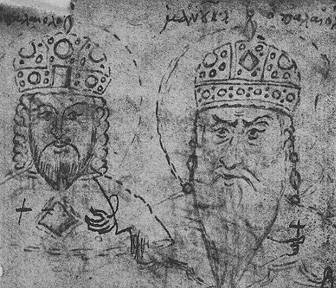
Manuel II (right) with his son, John VIII.
[H/t to Bill Cork for the link.]
[Update: Oh, and yes, the Manuel II quote is remarkable. Especially when you consider that Benedict XVI is a careful thinker and speaker, and his full awareness of the probability of controversy by using it. I'm still mulling it, and will have more later. Thoughts are welcome, of course.]
Thursday, January 05, 2006
Küng Kong.
Much talk of late regarding the fissures in the Catholic Church, and how to possibly bridge them. From the gray borderlands between "conservative" and "traditional" Catholicism, I'd like to offer a suggestion to my "progressive" brethren:
Try not to talk about yourselves, your heroes and your opponents in ways that make me want to blast you out of the Gucci saddle of your high horse with both barrels.
Exhibit A, this little squib from Robert Blair Kaiser in the (please sit down) Reporter, which manages the difficult trick of being both insufferably triumphalist and nauseatingly twee at the same time. Kaiser won awards for his coverage of Vatican II while he worked at Time. Interesting, at least in the academic sense, because there's no evidence of anything apart from award-winning self-regard here.
The subject? The Teutonic Colonic Himself, Hans Küng, whose theological endeavors are now quite appropriately focused on his favorite topic: Himself. He's in the midst of a truly Extra Absorbent multi-volume autobiography. The first installment clocks in at 533 pages, and goes through 1968.
At this point, I'll simply note that Carl Bernstein was only able to crank out 592 pages about the late pope's life through 1996.
Sounds like a whole lotta Küng. Editor? Though, in all fairness, when he isn't bent on shanking Mother Church, he can be formidable, indeed. I own Does God Exist?, and it is worth your time, though he stumbles slightly at the end.
If he’d played his poker hand differently, Hans Küng could have been pope.
There are three certainties in life. (1) Death; (2) Taxes; (3) You will aspirate your beverage at least once reading a copy of the National Catholic Reporter.
Ooookay. I guess that whole infinite universes hypothesis makes it possible--"possible" being a very elastic term. Though the likelihood of him becoming Pope is on roughly the same order of probability as me getting the job, and we're both less less likely than Elvis. Note also the beginning of an ill-developed, if still tiresome, poker theme.
The turning point in his life came when Pope Paul VI called Fr. Küng in after the fourth session of the Second Vatican Council and said, “You know you could really help the church.” The pope was hinting that Fr. Küng could get along much better in the postconciliar church if he’d just go along with the papal party in the curia.
Any source for this story other than the bilious memory and limitless capacity for nursing grievances and slights possessed by Fr. Küng? I'm not saying there was no meeting, I'm just not buying The Last Temptation of Küng implications. I'm also not fussy about the quality of the corroboration--for example, I am willing to accept the testimony of Co-Co, the Curial Lemur. Anyone? Bueller? At most, it's his spin on the offer ("The [P]ope was hinting..."). Anyway, the anecdote is just a set-up to illustrate the Steely Integrity of Our Hero.
Fr. Küng didn’t want to get along, much less go along.
Fight the power! K to the Umlaut to the N to the G! HK is in the hizzouse!
Much talk of late regarding the fissures in the Catholic Church, and how to possibly bridge them. From the gray borderlands between "conservative" and "traditional" Catholicism, I'd like to offer a suggestion to my "progressive" brethren:
Try not to talk about yourselves, your heroes and your opponents in ways that make me want to blast you out of the Gucci saddle of your high horse with both barrels.
Exhibit A, this little squib from Robert Blair Kaiser in the (please sit down) Reporter, which manages the difficult trick of being both insufferably triumphalist and nauseatingly twee at the same time. Kaiser won awards for his coverage of Vatican II while he worked at Time. Interesting, at least in the academic sense, because there's no evidence of anything apart from award-winning self-regard here.
The subject? The Teutonic Colonic Himself, Hans Küng, whose theological endeavors are now quite appropriately focused on his favorite topic: Himself. He's in the midst of a truly Extra Absorbent multi-volume autobiography. The first installment clocks in at 533 pages, and goes through 1968.
At this point, I'll simply note that Carl Bernstein was only able to crank out 592 pages about the late pope's life through 1996.
Sounds like a whole lotta Küng. Editor? Though, in all fairness, when he isn't bent on shanking Mother Church, he can be formidable, indeed. I own Does God Exist?, and it is worth your time, though he stumbles slightly at the end.
If he’d played his poker hand differently, Hans Küng could have been pope.
There are three certainties in life. (1) Death; (2) Taxes; (3) You will aspirate your beverage at least once reading a copy of the National Catholic Reporter.
Ooookay. I guess that whole infinite universes hypothesis makes it possible--"possible" being a very elastic term. Though the likelihood of him becoming Pope is on roughly the same order of probability as me getting the job, and we're both less less likely than Elvis. Note also the beginning of an ill-developed, if still tiresome, poker theme.
The turning point in his life came when Pope Paul VI called Fr. Küng in after the fourth session of the Second Vatican Council and said, “You know you could really help the church.” The pope was hinting that Fr. Küng could get along much better in the postconciliar church if he’d just go along with the papal party in the curia.
Any source for this story other than the bilious memory and limitless capacity for nursing grievances and slights possessed by Fr. Küng? I'm not saying there was no meeting, I'm just not buying The Last Temptation of Küng implications. I'm also not fussy about the quality of the corroboration--for example, I am willing to accept the testimony of Co-Co, the Curial Lemur. Anyone? Bueller? At most, it's his spin on the offer ("The [P]ope was hinting..."). Anyway, the anecdote is just a set-up to illustrate the Steely Integrity of Our Hero.
Fr. Küng didn’t want to get along, much less go along.
Fight the power! K to the Umlaut to the N to the G! HK is in the hizzouse!
After creating immense enthusiasm for the council with his preconciliar bestseller, The Council, Reform and Re-Union,
The enthusiasm for Das Buch has since assumed room temperature. Out of Print.
Fr. Küng, as a peritus
Exhibit No. MMMMMCVXI demonstrating that episcopal personnel decisions are the polar opposite of infallible. But you already knew that.
(a theological expert) at the council, had done battle during the council’s third and fourth sessions with the forces of no-change inside the Roman curia that were clinging to hierarchy despite the majority’s efforts to democratize and decentralize the church.
The great Myth of the Council cherished by those sitting in the left side of the pews. Also known as the Rynne Spin. Given the consensus-building ambiguity in the documents themselves, determining what the "majority" wanted is frequently an exercise in Talmudic spelunking. But there is no doubt whatsoever Prof. Küng has it in for the Curia. After all, he's not running it.
And I especially enjoy the Scooby Doo-ish description of "battle...with the forces of no-change...."
"If it hadn't been for you meddling periti and that dog..."
“I didn’t want to serve
Heh. Non serviam.
OK, OK. Too easy, but irresistible.
And what's this "hierarchical church" I keep hearing about? I have problems with buckets of archbishops, bishops, priests and deacons, but they are part of the Church. Been that way since the first century, like it or not. And Fr. Küng definitely does not like it.
the hierarchical church,” Fr. Küng told me recently during a two-day visit to Phoenix. “I wanted my writing and my research to serve the people of God.” His thinnest (but most powerful) book, Infallible? An Inquiry,
So powerful that it's also out of print. But it is a metaphysical certainty that it is still available at the li-berry of your local Catholic™ emporium of higher learning (and even higher tuition).
hit at the heart of papal absolutism. It put him on John Paul II’s
For whom Küng bears a bottomless well of pure hatred. Probably one of those German/Polish things.
Score one for Poland.
hit list, and, suddenly, Hans had to fold his hand and find another game.
Meanwhile, his colleague at the council, Joseph Ratzinger, decided to go along,
See--some progressives still believe in apostasy. And the sin against the Holy Ghost is most assuredly apostasy from aggiornimento. But you have to believe really, really hard in the Myth--and subject yourself to the spin cycle on a daily, brain-damaging basis--before Santa will give you a sleigh bell.
Yessirree, Joseph Ratzinger was surely and purely a craven toady void of any intellectual or moral integrity whatsoever.
and proceeded on a career path that poker players might call a long winning streak.
Again with the poker. Memo to the drowsy NCR editor: Jai-alai players might call it a long winning streak, too. Ditto the masters of curling. Use that red pen, dammit.
Back to the point: People who kvetch about "the hierarchical church" while drinking deep from the well of clerical politics might call it "a long winning streak."
Others might call it a life of service to the Church.
Even poker players.
After a brief stay at Fr. Küng’s University of Tübingen, Germany, Fr. Ratzinger became the archbishop of Munich, and a cardinal, and, four years later, prefect of the Congregation for the Doctrine of the Faith, formerly known as the Holy Office, in Rome. Twenty-five years later, when Karol Wojtyla died, he was perfectly positioned to be the next pope.
Lord, how refreshing: A reference to the CDF as the Inquisition. Straight from The Tired Leftist Hack's Style Manual for Writing About Roman Catholicism, p. 1. Other helpful tips: fish on Friday quips and comments about taking the express elevator to Hell for missing Mass.
"Perfectly positioned." Yeah--the fix was in. Because, as everyone knows, agreeing to become the doctrinal heavy at the Vatican is the passport to universal popularity (see Panzerkardinal, God's Rottweiler, Enforcer of Faith). Which is why everyone really said he had no shot. Just ask Fr. McBrien.
Had Fr. Küng taken the cue given him by Pope Paul, he could have been a formidable contender -- as Cardinal Küng -- at the conclave of 2005.
Because all the periti were put on the fast-track. Not.
Then there's that little matter of his personality. I remember watching an interview of him included on a Vatican II CD-ROM available at our parish. "Axe to grind" and "ungracious" doesn't begin to describe it. The guy could curdle water.
But wait--here Mr. Kaiser gets his meme confused. After all, what makes Hans Küng the Shining Beacon of Selfless Christlike Service to The People of God is his gutsy refusal to play by the rules, right? A sort of Deutsche Duke boy against the Curial Boss Hoggi. Jeee-ja!
But now Mr. Kaiser wishes he'd caved in like that lousy rat fink scab Ratzinger.
Wha--?
Cardinal Ratzinger, for all his intelligence and political skills, was (and is) a pallid, timid man with limited people skills. (I could compare him with President Richard Nixon’s security adviser, the sober Robert MacFarlane.)
If Robert McFarlane (note spelling) had been Nixon's NSA, of course. He wasn't. He was Reagan's. Nixon's was this obscure fellow named "Henry Kissinger."
At the conclave, a vibrant Cardinal Küng might have been another Jack Kennedy, full of fun and alive with ideas for the church’s new frontier.
And now our man of unbending integrity/clerical rat fink transforms into a celibate JFK/Lenny Bruce hybrid. From alternate history to fantasy, in one sentence.
I'll have what Mr. Kaiser's having. Make it a double.
Fr. Küng, of course, found another game. He started working with leaders of the world’s great religions and founded his World Ethic Foundation in Tübingen to enlist all the major religions in the common search for peace through dialogue. “There will be no peace in the world,” he insisted, “without peace among the religions, there will be no peace among the religions without dialogue, and no dialogue without emphasis on a common ethic. Without dialogue, we shoot each other.” In 2003, England’s Prime Minister Tony Blair came to Tübingen to give the Global Ethic Foundation’s inaugural lecture. In May 2005, Fr. Küng went to Tokyo to receive the Niwano Peace Prize, Japan’s version of the Nobel Prize.
Not a bad idea there: "Jaw, jaw, jaw is better than war, war, war," as Churchill famously said. Though he admittedly had exceptions to that one. Nevertheless, it definitely beats passing off his theological freelancing as cutting edge Catholic thought.
I am curious, though: How is it playing in Tehran?
Hans has been a friend of mine since the heady days we shared at Vatican II. I had no trouble, then, persuading him to visit Phoenix in November as part of a campaign by the Jesuit Alumni in Arizona to promote a thinking church.
There is no catchphrase in the dividing American church that sets me off quite like "thinking Catholic." Or now, Mr. Kaiser's less-felicitous "thinking church."
Every single time I hear it, it's being used by "thinkers" who are in the midst of uncritically regurgitating someone else's stale ideas.
Exhibit No. 124 for the prosecution.
I was pleased to see that, at age 77, he has the same trim, athletic figure he had 40 years ago, and the same fun-filled personality and boyish smile that he shone on the reformist bishops and theologians at the council.
As opposed to the other stuff he showers on everyone else.
He swims every day near his home in Tübingen, and he’s planning a two-week ski vacation this month in Austria. He did 40 laps in his pool at the Pointe Hilton at Tapatio Cliffs before he went off to a dinner and 80 laps the next day to prepare for his Saturday night lecture.
The only thing that came to mind here was a quote from actor Jay Mohr when he was guest-hosting The Jim Rome Show: "He's so buff he's gay."
Not that it has anything to do with this, but I've always wanted to use that line.
Thomas Olmsted, bishop in Phoenix for the past two years, demonstrated no sympathy for the version of a thinking church of Jesuit Alumni of Arizona or for Fr. Küng’s presence either.
Gosh, how interesting that it took until after Bishop O'Brien had his desert Chappaquiddick for JA of A to start cogitating about a "thinking church." Apparently problems just magically appeared in Phoenix with the arrival of + Olmstead.
He declined to be part of the interfaith event in Phoenix,
WHAT "interfaith event"? This fact just materializes in the midst of the groupie-ish hero worship. Whatever they paid the NCR editors for work on this article, it was too much. And that includes squirrel pelts.
he blocked attempts to advertise it in parish bulletins or on the diocesan Web site, and told the group it couldn’t offer complimentary tickets to seniors in six Phoenix area high schools
What a crippling blow to attendance by The Yutes. Because, as we all know, there's nothing American high school seniors would enjoy more than listening to a German theologian piss, moan and preen on a Saturday night.
, or to the priests and laypeople working in his office.
Olmsted explained through his chancellor that Hans Küng “doesn’t have faculties to teach as a Catholic theologian.”
Absolutely true--followed on the heels of an extensive investigation, too. Which means that the only possible rebuttal by a "thinking Catholic" is to arch his back and hiss from the top of the cupboards.
He was referring to a Vatican decree of 1979 that said that Fr. Küng, though still a priest in good standing, had lost his license to teach Catholic theology. That declaration had a pre-conciliar,
See The Tired Leftist Hack's Style Manual For Writing About Roman Catholicism, p. 4.
inquisitorial
See The Tired Leftist Hack's Style Manual, p. 1.
whiff about it that reminded millions of Catholics of nothing so much as the church’s Index of Forbidden Books,
See The Tired Leftist Hack's Style Manual, p. 2.
which was abandoned at Vatican II.
M.J. Benton, owner of Essentially Books in Scottsdale, testified to Fr. Küng’s ongoing popularity. “I can’t keep his books in the store,” she said. “I’ve sold almost a hundred copies of his memoir [My Search for Freedom] in the past month, and I keep selling two of his works in paperback, Global Ethics and Women in Christianity.”
At this point, I get to employ the same dismissal used by my progressive sistren after being told of the vocational upticks after papal visits to America: "call me in two years." And I'll be happy to examine the remainder bins.
Fr. Küng’s publisher, Eerdmans,
A Protestant publishing house, which I only mention (I own a couple of Eerdmans books) because it's rather surprising it wasn't picked up by one of our Ex Corde-allergic emporia or Orbis or Maryknoll.
reports it has “almost sold out the memoir” and is waiting with some eagerness for the second volume.
It's going into its third year since being published. The initial print run is the key to determining "runaway best-seller" status.
Ms. Benton says Fr. Küng appeals to contemporary Americans because “he has found a peaceful way of settling differences between religions.”
Has he now? While it's a perfectly decent idea, some actual examples of settlements would be nice before I'm willing to take a pull at that carafe of Kool-Aid.
By Friday night, Jesuit Alumni of Arizona had sold 550 advance tickets to Hans’ Saturday night lecture. On Saturday morning, The Arizona Republic carried a Page One story reporting the bishop’s efforts to squelch it.
Read: Not promote it on the dime of the faithful.
On Saturday night, a crowd of more than 1,100 laughing, exuberant Catholics, a good many friendly Protestants, and a scattering of Jews, Muslims, Buddhists and Hindus showed up to applaud Fr. Küng’s message, that there is great good in every religion, and that people of all religions can make the world a more peaceful place.
And I'm just sure Prof. Küng fired no shots at his own Church. None 'tall.
Dangerous stuff for loyal Catholics, right?
I wouldn't know--I can't think.
Saturday, May 14, 2005
Progressive Anglicans: "Is it cold in here?"
B-16 has a stiff arm technique worthy of Gale Sayers:
Thus, it was significant that Archbishop of Canterbury Rowan Williams attended the inaugural mass for Benedict XVI, becoming only the second occupant of the throne in Canterbury to witness such a rite since the Reformation. Afterwards, the former Oxford don greeted the pope in German and presented him with a pectoral cross.
Ah, yes, but journalists and photographers paid close attention to the precise details of this rite of reception.
"Symbolism is everything," opined David Virtue, a conservative Anglican whose Internet reports circle the globe. "When the new pope met with the patriarchs from the Orthodox churches there were public embraces and kisses, but when Benedict XVI met Williams there was only a handshake. ... Williams edged forward perhaps hoping for a papal embrace but it was not forthcoming."
Keep this in mind whenever you hear of the Pope's willingness to engage in ecumenical dialogue. It will not be of the variety that only doffs the "Kick Me!" placard when he gets in the dunk tank.
B-16 has a stiff arm technique worthy of Gale Sayers:
Thus, it was significant that Archbishop of Canterbury Rowan Williams attended the inaugural mass for Benedict XVI, becoming only the second occupant of the throne in Canterbury to witness such a rite since the Reformation. Afterwards, the former Oxford don greeted the pope in German and presented him with a pectoral cross.
Ah, yes, but journalists and photographers paid close attention to the precise details of this rite of reception.
"Symbolism is everything," opined David Virtue, a conservative Anglican whose Internet reports circle the globe. "When the new pope met with the patriarchs from the Orthodox churches there were public embraces and kisses, but when Benedict XVI met Williams there was only a handshake. ... Williams edged forward perhaps hoping for a papal embrace but it was not forthcoming."
Keep this in mind whenever you hear of the Pope's willingness to engage in ecumenical dialogue. It will not be of the variety that only doffs the "Kick Me!" placard when he gets in the dunk tank.
Subscribe to:
Posts (Atom)
New digs for ponderings about Levantine Christianity.
The interior of Saint Paul Melkite Greek Catholic Church, Harissa, Lebanon. I have decided to set up a Substack exploring Eastern Christi...

-
Being a little worn out and dispirited over comboxing (at Jay's, primarily, and also the invaluable American Catholic), I'll instead...
-
 The interior of Saint Paul Melkite Greek Catholic Church, Harissa, Lebanon. I have decided to set up a Substack exploring Eastern Christi...