I'd barely had a chance to process my vertigo about the first interview when the second broke. I have a more detailed list of concerns about it for another post, but I'm just going to focus on the popular conversion exchange:
And here I am. The Pope comes in and shakes my hand, and we sit down. The Pope smiles and says: "Some of my colleagues who know you told me that you will try to convert me." It's a joke, I tell him. My friends think it is you want to convert me. He smiles again and replies: "Proselytism is solemn nonsense, it makes no sense."
The point is, Scalfari was talking about conversion, not coercion. From the context, it doesn't appear the Swiss Guards had their halberds menacingly lowered at Mr. Atheist. Scalfari was making a joke about mere conversion, not force.
Here's an analogy: an Eckrich salesman invites me over to his house, and I joke "Are you going to try to sell me some hot dogs?" and he replies: "Bratwursts are ridiculous."
Er...all right.
Now, those of you who have no problem with the interview are probably going: "A-ha--see how clever the pope was: he was playing a smart rhetorical game with Scalfari here!"
Well, no. First, is it fair to Scalfari unlikely as he is to be up on the distinction between good evangelizing and bad proselytism? Isn't wordsmithing here a bridge too far?
Second, the distinction gets watered down later in the interview:
Your Holiness, you said that you have no intention of trying to convert me and I do not think you would succeed. "We cannot know that, but I don't have any such intention."
Okay...so...um...
I'm at sea here. Is any intent or desire for conversion of another, expressly-stated or not, proselytism?
Well, I respect Jimmy and Kathy a lot, but there's a difference between terminology in a limited, technical church-y sense and terminology as it is understood by non-believers. Jimmy especially notes the difference between the common and the church-technical version.
But none of that was stated in the actual text of the interview. He's not being more precise, for whatever reason. Unfortunately, he's not giving you the material to make him say what you want him to. When you have to supply that much subtext and cross-referencing to make it "work," it's damage control. Pure and simple. All damage control at this point, and that's how it comes across.
Non-Catholics have this rather exalted notion that the Pope is a dictator, we hang on his every word, and that we march to him lighting up the Pope Signal or getting the Secret Message from the PBS test pattern after sign off.
A message that is being--stunner!--reinforced by the way the Catholic Left is brandishing him. Francis, unfiltered! The world's parish priest!
Compare Jimmy and Kathy with David Gibson of the Religion News Service. Also a Commonweal blogger, to say Gibson hates your orthodox guts...is entirely accurate. As he demonstrated on his Facebook page today, linking to his own deeply objective story gloating about the discomfiture of people who actually believe in what marriage really means, that abortion is evil, who struggle to follow Humanae Vitae:
But compare the first Gibson link with the attempted rebuttals. Gibson simply lets Francis speak for himself. There's nothing for him to have to explain, no multi-paragraph excurses on wayward sentences, none of that. Because there's nothing there to discomfit him. And just where do you think regular journos will get their Francis stuff from? Hint: RNS, the National Catholic Reporter, Tom Reese, Dick McBrien--the usual gang on speed dial. Not from Patheos.
And where do you think the average Catholic in the pews (you know, the ones who say "gay marriage--suh-weet!") will get their Francis fix from? The regular journos.
And why not? Gibson, NCRep, etc. are all poised, confident, and not engaging in damage control. But their read is wrong--or so I'm reassured.
He first characterized the bombing as a "horrific act" without a shred of justification. He praised the Christian community in Pakistan, now more fearful than ever, and noted that he himself was educated by Catholic priests and later by Presbyterians. He counts many Christians as friends.
So I asked him point-blank, "Was this bombing an act of religious discrimination?" Was it religiously motivated? Without hesitation, he said, "No." He pointed to a statement from the Taliban themselves saying it was a response to the United States' frequent and continuing drone attacks in the tribal areas of Pakistan. He said the Pakistani government's protests to the United States have been unable to stop the drones, so the frontier tribes have resorted to their ancient "eye for an eye" response to perceived injustice.
Nice to see Dr. Ahmed has "many" Christians as friends.
Much like the white bigot who's "friends with a black guy."
Say what you will about the Reporter, they always manage to find a new low. And if Catholics ever go into ghettos, you can guess from whose ranks the authorities will recruit the Order Police from.
OK, upon further reflection, it's not that worrisome.
The Catechism is quite clear that rash judgment is a bad thing:
"To avoid rash judgment, everyone should be careful to interpret insofar as possible his neighbor’s thoughts, words, and deeds in a favorable way: Every good Christian ought to be more ready to give a favorable interpretation to another’s statement than to condemn it."
CCC 2478.
True enough, and it has to be kept in mind at all times.
But there are some limitations. If a neighbor offers to make my family a dinner, I will assume that he does so out of kind decency and not because he's a serial-killing poisoner.
I will continue to make this assumption even if a godawful smell starts emanating from his kitchen whilst he cooks.
However, charity does not require me to believe that the meal will be a good one once the eau d'skunk wafting out starts making my eyes bleed. Nor does it require me to believe that my neighbor won an episode of "Iron Chef." Or "Chopped." Or even "Hell's Kitchen."
In other words, just because a gentleman might be trying to play 3D chess doesn't mean I have to think he's Garry Kasparov. Much less imagine he will be immune from making some awful moves.
I know. I'm just "more Catholic than the Pope." Pharisee wanting a small church getting smaller, repel boarders, fortress Catholic, et cetera, et cetera, et cetera.
Whatever. Once I manage to make sense of this, I might make some progress:
"The Council Fathers knew that being open to modern culture meant religious ecumenism and dialogue with non-believers. But afterwards very little was done in that direction."
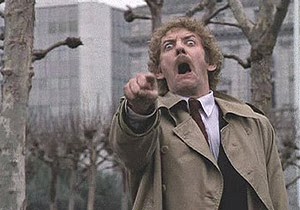
This is basically how I feel. Like the person Sutherland is pointing at the end of Invasion. Essentially, the Catholic world I know has been seized by body snatchers and is about to notice that I am not lining up to board the F1 to the Promised Land.
Yes, this is about the interview. Quick summary of my reaction: some very good parts, some easily-soundbitten ammo I can expect to see all over the place, but is still explicable in terms of preaching the Gospel, and a disastrous, giant ticking nuke about to blow us back to the Church of the 1970s.
SHRREEEEEEEIIIIIK!
The Interview Was Candy Mountain Awesome, Charlie! Everyone agrees--it was full of candy, and joy, and joyness! You don't believe that?
Yeah, well, I can live with that. Hier stehe ich. Ich kann nicht anders.
[Just to make the inevitable scream of "That's unclean Protestant talk!" a little easier.]
As I see it, there are three serious problems, two of which are related to how it's being received and processed, and the third is the nuke.
Problem 1: We Are All Ultramontaines Now.
Don't drag me into this, Americain. My Papa Pius would have cracked your skulls
as the opener for the ritual of excommunication. Then he'd have gotten mean.
Including--nay, especially!--people who have spent a generation ignoring, deriding or spinning away every encyclical, apostolic letter and motu proprio that flowed forth from the pens of John Paul II and Benedict XVI.
But an interview--in America Magazine--well, my God! It's new tablets from Sinai! And we can play historical critical whiteout with the parts we don't like! Is it Elohist or Deuternomic? Forget it--we'll figure it out later! Anyway--miraculously--we agree with the whole thing! (More of which later.)
A 44th Edition including The Interview! is no doubt being prepared as we speak.
As an aside, it's good to see the Jesuits at America released from the dungeons after the long night of Benedict the Destroyer. The shackle chafe marks being no doubt hidden under the long sleeves. Some advice: sunlight and a vitamin regimen will banish the sallow complexions.
But, really, uniform praise--especially this wall-to-wall and adulatory--makes me uneasy. There's something fundamentally off about it. In fact, the adulation being heaped on Pope Francis is general is...odd. I mean, it's almost like he's being given a prize for not being Benedict. That's certainly the case on the Catholic left, which is transferring its creepy cultish adoration of Obama, the Not-Bush, to Francis, the Not-Benedict. Benedict the Rottweiler, Who Can be Safely Archived and Forgotten Like a Bad Dream In This New Age.
What the right's deal is, I don't know. The Pope Says We Must Re-Balance, So We Must Re-Balance. It smacks too much of a new CEO coming in, and everyone having to get with the program. At a minimum, it's a feverish celebration that has no parallels with how it received Benedict, which was more defensive and apologetic, and less effusive in its praise.
You saw nothing in the interview heralding trouble, eh? Nothing at all?
The fact both are united in swoonery suggests that one or the other is missing something. And someone is, as we shall see in Problem 3.
The response to this from the so-called orthodox? The Left must not have read it. They're reading it through a MSM lens. If they read it, they misread it.You're being morose, Eeyorish and depressive.
Translation: Looks like someone's got a case of the Mondays! Turn that frown upside down! Let a smile be your umbrella!
Allow me to retort:
To suggest that they have all misread it and/or are delusional is itself delusional. When was the last time they were this energized? Never. Not in my Catholic lifetime.
Anybody on the left feeling betrayed, cast aside, discounted, demoralized, even a sense of disquiet? Nope. That's a telling datum, don't you think? To which I hear NO, FROWNY FACE, IT IS NOT. GET WITH THE PROGRAM.
Rex Mottram Lives!
Alas, I am not honestly able to say that the Left is wrong in how they received this.
And why is that? Because there's a flat-out admission from the Bishop of Rome's that his preferred governing style is much different, and much more to their liking. It will, in fact, let their good times roll. Disco pants and haircuts and Jadot, all the way down.
Problem 3: The Nuke.
There are all sorts of small rhetorical problems with the interview, easily sound-bitten parts that are being used by the Left--and occasionally the knife-happy non-left that hates pro-lifers--with glee: "obsessed," "small-minded rules," etc. Can you find any soundbites to fling back at the retrograde, unChristian behavior of progressives? Let me know.
Hint: there aren't any.
Still, to a large degree, they can be dealt with, and credibly, as an evangelization imperative: the good news is not that abortion is a moral abomination (though it is), but rather that Jesus Christ is God the Son, who became incarnate, died for our sins and rose for our salvation. When people get a grasp on that mystery, you can build upon it:
When He did so, He established a Church of believers, guided by God the Holy Spirit, who witness to the unalterable truth that murdering infants in the womb is a horror to be rejected. Because, after all, Jesus the Risen Savior of us all, lived in the womb, too.
OK. That's doable. The soundbites will still be misused, to great mischief, but that's manageable.
But there's one that can't be spun.
I am baffled that no one else has commented on it. It was impossible to miss it. America, recognizing the significance as orthodox commentators have not, conveniently blew it up in bigger "Peace In Our Time!" type for easy reading.
Because it's important. In fact, administratively-speaking, it was the most important damn piece of the interview. Here it is, as it appeared in America:
I ask the pope what he thinks of the dicasteries of the Roman Curia, the various departments that assist the pope in his mission.
It is amazing to see the denunciations for lack of orthodoxy that come to Rome. I think the cases should be investigated by the local bishops’ conferences, which can get valuable assistance from Rome. These cases, in fact, are much better dealt with locally.“The dicasteries of the Roman Curia are at the service of the pope and the bishops,” he says. “They must help both the particular churches and the bishops’ conferences. They are instruments of help. In some cases, however, when they are not functioning well, they run the risk of becoming institutions of censorship. It is amazing to see the denunciations for lack of orthodoxy that come to Rome. I think the cases should be investigated by the local bishops’ conferences, which can get valuable assistance from Rome. These cases, in fact, are much better dealt with locally. The Roman congregations are mediators; they are not middlemen or managers.”
Translation:
Yes, yes, yes. He excommunicated a po-faced Aussie priest-heretic whose case was in the pipeline before he became Bishop of Rome. Whoop-de-doo. But faced with his astonishment at the complaints about orthodoxy, the message is clear: Stop sending me this stuff. We're not going to be "censorial." We're mediators now. That title is "Bishop of Rome." Collegiality. Mediatorial.
Bishops, being men with careers, will take the explicit hint. And so will wayward clerics, theologians, religious, etc. Rome has left the barn door open. And the toothless, juridically-impotent bishops' conference will "handle" it instead. Boo-yah. But gingerly, because HQ doesn't want to see this stuff. How, of course, one is supposed to "mediate" between the faith of the Church and the evergreen popularity of "the apostles hid Jesus' corpse but good!" is unclear. And let's remember Benedict's Reign of Terror meant that--gasp!--the censured theologians got tenure at other schools. The horror....the horror...
Then again, it might work. Hey--maybe this guy's Catholic. He was a mediator between geniuses, so this is right up his alley:
Yeah, I know. I've been snarky, sardonic and flip. But that's the only way I can keep from smashing my head into the desk. We're in for an extraordinarily-bumpy ride. I'm feeling demoralized, frankly. The alleged obsession with abortion, contraception and gay marriage is the most well-hidden one I've ever encountered, as the first only rarely, and the second and third never, have rung from any pulpit I've attended. I've heard God called "She" more times than I've heard homilies about contraception. Given the personal difficulties and conflicts my wife and I have had to "enjoy" for our decisions to be open to life, it was of some reassurance that at least the Pope had our back. The Bishop of Rome seems to have a different outlook about that, and we're all the more alone as a result.
I don't mind carrying my cross. I just don't appreciate Catholics adding sandbags to the burden.
I've been thinking--if obviously not writing--a lot lately about the future of Catholicism in America and what role we as Catholics can play during these times. With an overweening Caesar (oh, hai, NSA!) walking in tandem with atomistic individualism (the latter deluding himself that he's striking blows for freedom against Caesar, never noticing how the latter grows ever larger), we are in for a rough ride.
Being a lawyer and a history nerd, I naturally starting casting about for precedents, starting with the Catholic experience in America. It was at that point that it hit me, and I hung my head in shame: I know precisely bupkis about the American Catholic experience. Oh, sure--the Saints come to mind: Elizabeth Ann Seton, John Neumann, Katharine Drexel, saint material like local icon Solanus Casey...then it peters out. Sure, the Irish Potato Famine, and the K of C also leap to mind, partially formed, as emblems of the American Catholic experience. But...as a coherent whole, I'm embarrassingly at sea.
But wouldn't they have examples for dealing with a hostile and uncomprehending fellow citizenry? I knew enough, however vague, that it was far from a love feast when mackerel snappers arrived on these shores. But it was--and still is--vague.
I'm also acutely aware that current political debates between American Catholics have an embarrassingly short-sighted ring to them, largely agreeing that the world began in 1965, privileging continental European models as objects of discussion, and sounding as a whole disconnected--"Americanism!" "The Founders were Deists!" "Encyclical X/European Catholic philosopher Y settles your CINO hash!" Extremely unsatisfying-to-offputting, and sometimes with a flavor of bad scholasticism mixed with stale casuistry, all larded with a sense of detachment.
Aren't there faithful American examples to call on? Writers who spoke forcefully and clearly to the American experience without sounding like they just cleared customs on a flight from the Continent, here to deal with the half-barbarians?
Well, yes there is and are. As is my wont, I started digging through books (older, mostly, as they are divorced from the current toxic partisan environment) and am happy to offer them up.
Being a convert myself, I stumbled across In No Strange Land: Some American Catholic Converts, by fellow Methodist convert Katherine Burton. Focusing on 19th Century converts, I had heard of precisely two of the persons memorialized in this fine anthology: Orestes Brownson, and Fr. Isaac Hecker. None of the rest, and that's a shame. You'd have thought that the first Protestant bishop to convert to Catholicism since the Protestant Reformation would be worthy of note, but I'd never heard of Levi Silliman Ives. Nor any of the rest. But there is a fascinating common thread: they all converted to a faith that was regarded as an alien, irrational intruder, little more than an Italian mission in the New World catering to immigrants. And they had to deal with the hostility of their family and friends, along with clerics who were often none too deft, uncomprehending or unable to offer more than moral support--the Church was a poor institution Stateside. Still, they persevered and offer examples on how to persevere, with Ives being an icon of charity and humility, gladly working part-time jobs after losing his episcopate. It is definitely worth your time, and is available from reprint houses.
Philosopher Orestes Brownson towers over the 19th Century American Church, but if there was any justice, he'd tower over Emerson and Thoreau, having been a fellow Transcendentalist but a far more incisive writer and philosopher. If you want to talk productively about American politics from a Catholic perspective, get this post-haste: The American Republic: Its Constitution, Tendencies and Destiny. Insightful and incisive, Brownson speaks to the American experience (through the end of the Civil War) as a patriotic Catholic son, albeit one not shy about offering fair criticism. It's a salutary tonic for what ails Catholic political punditry in America.
But wait, there's more: Bradley Birzer's biography of the Catholic founder Charles Carroll, entitled American Cicero. Birzer deftly explains how the devoutly Catholic Carroll had no difficulties participating in what too many of my contemporary brethren deride as a misbegotten deist enterprise. Carroll's discomforts with the excesses of mass democracy are also explored, and appear prophetic. It's worth reading as a snapshot of the dismal state Catholics in Maryland had been reduced to by the eve of the Revolution, but fortunately Birzer has much more to offer.
Finally, the Rev. John Cronin's Catholic Social Principles, despite being more than 60 years old, still has a lot to offer discussion of American economic issues. If for nothing else, the extensive bibliography is a goldmine. But what is especially helpful about Father Cronin is that he takes care to faithfully explain Catholic social teaching in a way that is sensitive to how it will be heard by Americans--to ensure that it will be heard, and not waved away. It's a difficult balance, and one too often blown today by glib partisans given to slogans like "the Church condemns capitalism and communism/statism equally!" Well, no.
Anyway, that's the start, with more to come as I try to set my intellectual house in something resembling order.
You see, it's my left middle finger (a/k/a "the auxilliary talking finger," "I-think-you're-#1-and-I-really-want-you-to-see-it finger," "the tall finger of fellowship"). What letter does that finger access most often?
The "E."
Oy.
So, yeah, typing.
I had something of a mishap with my electric hedge trimmers, he says with English understatement. Fortunately, I still have the entire digit, but it's broken and has 2-4 more weeks before it heals entirely. More fortunately, none of my children saw it happen, nor did they see me bleed like a killing floor. I remained fairly stoic, or at least did so in my mind. It could have been much, much worse.
Before that, I had the Annual Kids Activities Schedule Blitz, which turns May into a disorienting swirl of travel, recrimination and shared misery. So, of course, we'll do the same thing next year. But that puts the kibosh on writing and pontificating (but I repeat myself).
Heather's fine, the kids are fine (even if Kamikaze Louis is shaving hours off my lifespan every day), and even my 10% pay cut (speaking of "shared misery") hasn't been as gruesome as feared.
Not sure what I can promise, posting-wise, but at least I'm still alive-ish and largely unmaimed, which allows for the possibility. Random short reviews from the library has a certain manageable appeal.
We shattered the family and called it 'liberation.' We elected grifters and called it 'self-government.' We pillaged the future and called it 'prosperity.' We lionized theft and called it 'commerce.' We scorned our heritage and called it 'education.' We disposed of the helpless and called it 'freedom.' We laughed at virtue and called it 'enlightenment.'
There is no area of American politics in which the press is more activist or biased or unethical than social issues, the so-called culture wars. And the culture of permissive abortion they favor has consequences, which they would rather not look squarely at, thank you very much.
[Quote from here.]
Here's some unsolicited advice for social conservatives: never, ever speak to large-circulation newspapers or television networks.
Why not? Because they our enemy, that's why. They have concocted a narrative of breath-taking mendacity regarding us: we're authoritarian haters, patriarchal tyrants straight from the pages of The Handmaid's Tale, and/or killers of "providers of women's health services." Period. Stock villains, to be quoted briefly, if at all, and subject to well-poisoning adjectives like "strident," or "militant," or "inflexible." And if there is a story that indicates social conservative arguments have merit, or threatens to move the ball in that direction--it gets downplayed or embargoed.
This will never end--they will never quit doing this--until the entire edifice of fraud goes bankrupt.
Inducing live births and subsequently severing the heads of the babies is indeed a horrific story that merits significant attention. Strange as it seems to say it, however, that understates the case.
For this isn't solely a story about babies having their heads severed, though it is that. It is also a story about a place where, according to the grand jury, women were sent to give birth into toilets; where a doctor casually spread gonorrhea and chlamydiae to unsuspecting women through the reuse of cheap, disposable instruments; an office where a 15-year-old administered anesthesia; an office where former workers admit to playing games when giving patients powerful narcotics; an office where white women were attended to by a doctor and black women were pawned off on clueless untrained staffers. Any single one of those things would itself make for a blockbuster news story. Is it even conceivable that an optometrist who attended to his white patients in a clean office while an intern took care of the black patients in a filthy room wouldn't make national headlines?
But it isn't even solely a story of a rogue clinic that's awful in all sorts of sensational ways either. Multiple local and state agencies are implicated in an oversight failure that is epic in proportions! If I were a city editor for any Philadelphia newspaper the grand jury report would suggest a dozen major investigative projects I could undertake if I had the staff to support them. And I probably wouldn't have the staff. But there is so much fodder for additional reporting.
There is, finally, the fact that abortion, one of the most hotly contested, polarizing debates in the country, is at the center of this case. It arguably informs the abortion debate in any number of ways, and has numerous plausible implications for abortion policy, including the oversight and regulation of clinics, the appropriateness of late-term abortions, the penalties for failing to report abuses, the statute of limitations for killings like those with which Gosnell is charged, whether staff should be legally culpable for the bad behavior of doctors under whom they work...
Which sounds reasonable--except for the part where it's total bullshit. Trayvon Martin, Casey Anthony--and in Dickerson's case, the Kansas murder of abortionist George Tiller--all got plenty of column inches, despite not exactly being in the geographic wheel well of either paper. Here, squat.
Basically, what Dickerson and Kliff are doing is making sure horrifying facts about beliefs they hold dear--e.g., the necessity of permissive abortion laws--do not become widely known. Because if the facts did become well-known, people might start drawing the wrong conclusions, and start asking questions about those deeply-held beliefs. And maybe even asking for changes and restrictions.